
Triangular Power Politics: How The U.S. Limits Sino-Indian Alignment
March 24, 2026 - Written by Sharmin Miah
Amid ongoing U.S-Israeli strikes on Iran, Tehran’s Special Representative Abdul Majeed Hakeem Ilahi has accused the U.S. of perpetuating wars to obstruct the rise of emerging powers. This claim raises the broader question of how the U.S. can structurally constrain emerging global powers, particularly India and China.
This report examines how India and China engage with one another on the global stage, situating their relationship within a historical context and current geopolitical and economic dynamics. By analysing the evolution of Sino-Indian bilateral interactions, the current landscape, and the role of U.S. power and alignment, this work provides a comprehensive assessment of their relationship. It argues that India and China’s markedly different interactions with the U.S. are central to the shaping of their engagement with each other. Despite a sturdy economic interdependence, New Delhi’s close but rocky relationship with Washington, and Beijing’s historical political opposition to it, prevents deep political alignment between India and China.
Shared Borders, Historical Conflict, And Mutual Threat Perception
The relationship between India and China has remained concurrently strategically interdependent and adversarial. Deeply rooted in mistrust, this bilateral relationship has historically fluctuated between engagement and hostility. One element that highlights this is the border issues surrounding territorial integrity.
India and China’s shared border means that they historically share strong trade networks and cultural exchanges. Simultaneously, the shared border, otherwise known as the Line of Actual Control, has been the root of confrontation between the two nations. The ill-defined, 2,100 mile long border with glacial features that blurs boundaries, has been the major source of tension between India and China. Both countries have made attempts to build infrastructure along the Line of Actual Control, which has further exacerbated hostility. For example, the fatal clash with Chinese troops in 2020 was largely triggered by India’s construction of a high-altitude air base along the border. With both India and China making strong commitments to protecting their territorial integrity, this border dispute has been a major source of agitation between the world powers, risking severe escalation.
Tension has been deep-rooted in this bilateral relationship for decades. Beijing has historically not perceived New Delhi as an equal, unlike its perception of the U.S. and Russia as strategic peers. Since the Cold War, a mutual mistrust underpinned by a perceived threat to sovereignty has lingered above these bilateral relations. During the Cold War, China’s objective was to contain India, restraining any capacity to potentially harm China’s goal of regional hegemony. The shared border resulted in a never-ending and mutual security concern. Following the Cold War, China’s policy included employing Pakistan as a tool to “keep India in check”. China aimed to keep India nonaligned to reduce any threat to the periphery.
Constant antagonisation has entrenched both states in a self-reinforcing security dilemma, characterised by threat perception and fleeting moments of cooperation. This dynamic has been further intensified in recent years, with India’s alignment towards the U.S, to which China has historically positioned itself as a political counterweight. Ultimately, New Delhi views Beijing as an encircling and hostile threat in the region, whilst Beijing views New Delhi as a pawn of the West and a threat to regional hegemony.
Nonetheless, relations have been thawing more recently, which could signal a positive turn towards a cooperative relationship.
The Current Landscape: A Diplomatic Thaw Shadowed By Security Concerns And Climbing Exports
Indo-China relations appear to be thawing after the two nations reinstated direct flights after a five year suspension. After flights were suspended during Covid-19, they were never recommenced due to India and China’s ongoing border tensions. However, resuming these flights could signal a normalisation of the bilateral dynamic, indicating a step towards a positive point in their relationship.
India is no stranger to China’s encircling presence. The 1962 war, and the time leading up to it, was one of many instances of Sino-Indian border disputes. The Chinese annexation of Tibet made New Delhi feel further threatened by Chinese encirclement. More recently, India’s agitation grows due to China’s close ties to Pakistan, of whom India has had longstanding territorial tensions and armed conflict with. One reason being that Pakistan is the other claimant to Kashmir. Ultimately, the mistrust is deep-rooted and exists alongside thawing relations. The international community can hope that India and China’s economic interdependence pulls the nations towards stable cooperation.
Economically, New Delhi and Beijing are extremely important to each other. Their economic interdependence has been a crucial element that binds them together, ensuring stable financial prosperity. Trade between New Delhi and Beijing has been the most secure element of their relationship, as politics and military issues remain volatile. Indian exports to China are the most reliable aspect that will keep the nations bound together by desire to maintain economic success.
In 2025, Indian export performance vis-a-vis China strengthened substantially, with shipments to China rising 32%, hitting $12.22 billion. November alone accounted for a $2.2 billion increase, signaling a sharp acceleration in bilateral trade activity and strengthening demand. Demand for Indian raw materials increased as diplomatic relations between the two leaders were improving. Exports to the United States are also rising over 21% year-on-year, underscoring a positive momentum in India’s key bilateral trade partnerships.
As economic interdependence clashes with geopolitical pressures, India and China remain inseparably linked. However, a double-edged sword continues to define India’s export relationship with both China and the United States. The latter’s drastic tariff increase on Indian exports pushes India-U.S relations to an all time low.
U.S. Position On India
The geopolitical fallout from the Russia-Ukraine war continues to shape the global landscape with profound political and economic consequences. India’s continued embrace of Russian oil has triggered a point of friction with the United States, a significant political, economic, and military sponsor of Ukraine. This divergence has majorly strained bilateral relations with Washington, where India is now facing the economic repercussions.
In the middle of 2025, the U.S. hit India with a 25% tariff on imports, which then surged to 50%, for India’s perceived financing of Moscow’s war on Ukraine, Trump argues. New Delhi responded stating these claims were “unfair, unjustified, and unreasonable”.
As bilateral relations hit an all time low, keeping ties afloat remains imperative as the U.S. requires Indian technology, pharmaceutical, and agricultural exports, while India needs to export to the U.S. to sustain economic and trade prosperity. Washington has become increasingly uneasy with New Delhi’s continued defence and energy ties with Moscow, as the U.S. views India as a key ally in countering China’s rise in the Asia Pacific.
What becomes glaringly evident across the world stage is the constant trade-off between geopolitical rivalry and economic interdependence. States are navigating diplomatic tensions whilst relying on each other for economic growth and trade. How can India and China balance economic dependence with strategic mistrust?
Whilst China has consistently been firm in its opposition to the U.S, India’s strategic hedging or nonalignment means that it will not sustain long-term opposition. Thus, Chinese analysts are skeptical about India’s willingness to bind with China to create a common vision.
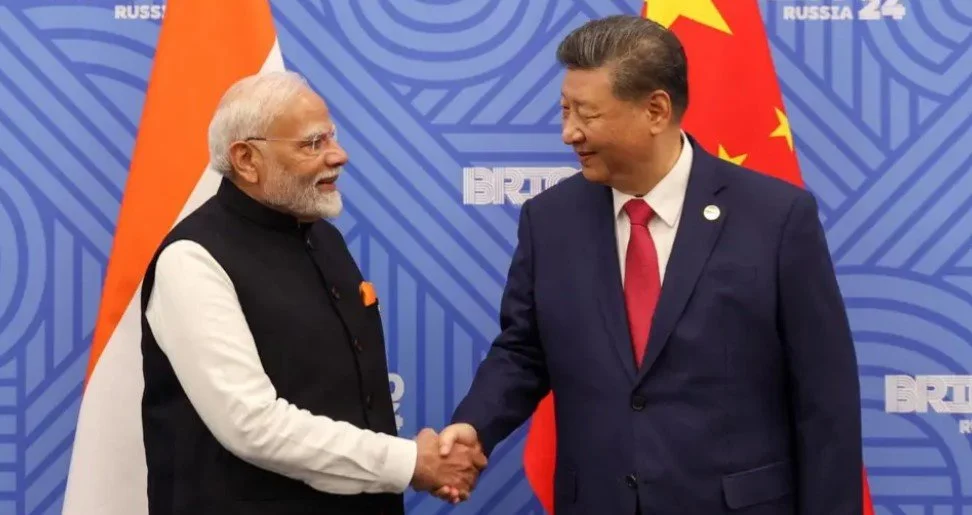
Despite Trump launching a trade war affecting Indian and Chinese economic interests, the dragon and the elephant have come together as bilateral relations between Modi and President Xi improve. Recently, Beijing and New Delhi reset ties after years of border tensions, economic hiccups, and political curbs with President Xi and Prime Minister Modi both stating their commitment to developing their cooperation.
Probable Outcomes
American structural constraints on Sino-Indian alignment:
India and China’s economic interdependence means they are inseparable, however, New Delhi remains politically nonaligned with Beijing. Modi and Trump’s recent resurrecting close strategic relationship reaffirms that Indo-China cooperation will never go beyond economic transactions. As long as Modi and Trump maintain this close relationship, India is likely to stay embedded within the U.S-led framework. In this context, India’s sustained political alignment with China, particularly against U.S influence, is impossible.
India fostering bipolarity in technology manufacturing:
As India ascends as a competing manufacturing base for global technology hardware, it is likely that China will upgrade its value chains as India should focus on diversifying its trade partners, to avoid reliance on the U.S and China. Apple, for example, is now outsourcing 25% of its global output in India.
This move is advantageous for India to prevent being stuck in a path-dependent situation. Within the backdrop of the calming tariff war, and Trump and Modi’s close relationship, it is foreseeable that Washington will pivot towards India as a key technology manufacturing partner, reducing dependence on Chinese supply chains. However, critics say this move will take years, as manufacturing in India is 5-8% more expensive than in China.
Strategic rivalry:
The four-way rivalry between Beijing, New Delhi, Moscow, and Washington could be a political necessity. It equips India with the diversification of trade it requires to avoid reliance solely on the U.S. or China. However, New Delhi must balance this trade-off carefully so as to not trigger its American partner.
In the near future, Sino-Indian relations are likely to remain shaped by pragmatic economic interdependence, rather than deeper political alignment, with the U.S acting as a structural constraint. India’s intensifying engagement with a U.S-led order, especially in technology and supply chain cooperation, will result in a bipolarity of global technology manufacturing.
New Delhi’s non-aligned strategy continues as the U.S. and Israel jointly strike Iran in early March of this year. Modi called for maximum restraint from all parties, supporting a diplomatic resolution, reflecting India’s non-aligned position. Yet, Modi has claimed to stand with Israel, “with full conviction”, suggesting a selective form of non-alignment that leans towards the U.S. and Israel.
Conclusion
From a long history of conflict due to shared borders and mutual threat perception, India and China have balanced their issues to preserve their strategic economic interdependence. The structural constraint of the U.S. eliminates any hope for a deep political alignment between New Delhi and Beijing.
Indian policymakers should prioritise strategic diversification to avoid overdependence on a single power. The most probable outcome is a managed competitive rivalry, with political ties to the U.S. getting stronger.
For China, this dynamic carries long-term consequences. As well as upgrading its value chains and accelerating technological self-sufficiency, Beijing is also likely to deepen alternative partnerships across the Global South. Consolidating influence in these regions through institutions and the strategic tech sector means China may shift towards a selective decoupling while maintaining economic connectivity where it is mutually beneficial.

Written by Sharmin Miah
Analyst on the Indo-Pacific Research Desk