
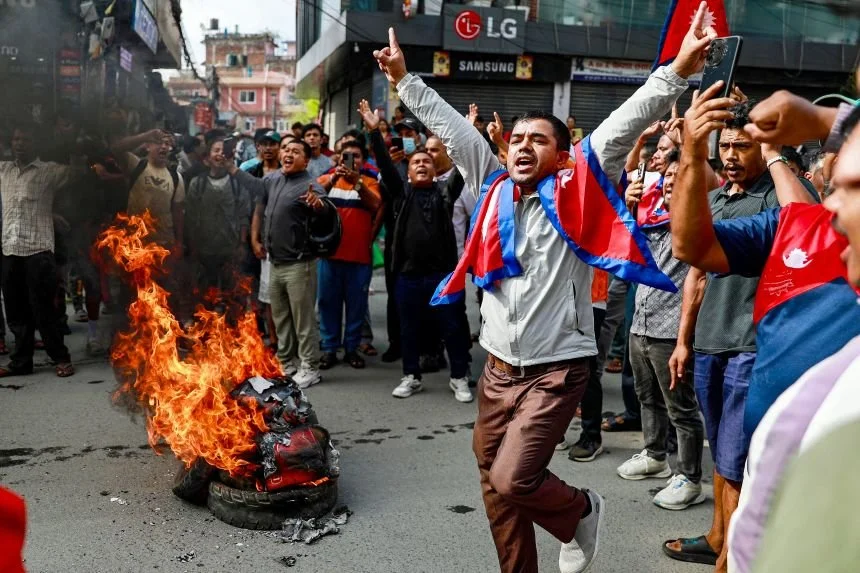
The Geopolitical Stakes of Nepal's National Election
March 20, 2026 - Written by Matthew Pheneger
Throughout 2025, a wave of youth-led protests broke out across the globe, capturing headlines and ousting governments. Whether in Serbia or Peru, Indonesia or Madagascar, this so-called Gen-Z movement is united across borders by shared frustrations among young people with rampant inequality, government corruption, and lack of opportunity. As a symbol of generational solidarity, many of the protestors display the ‘straw hat jolly roger’, a flag from the popular anime One Piece, which follows a youthful band of pirates who fight for freedom against a tyrannical world government.
The Kids Aren't Alright
One of the most significant Gen-Z protests occurred last September in the South Asian nation of Nepal. After government security forces shot and killed 19 protestors who were demonstrating against a government decree that banned popular social media platforms such as Facebook and X, thousands of young Nepalis took to the streets, demanding the dissolution of Nepal’s parliament and calling for new elections. Within a mere 48 hours, the protestors forced the resignation of Prime Minister K.P. Sharma Oli and appointed an interim government led by former Nepali Supreme Court Chief Justice Shushila Karki.
After months of careful preparations, the interim government recently convened new national elections on March 5th. Reporting from earlier this year suggests that nearly 19 million people were registered to vote in the snap elections, including over 800,000 first time voters. At least 125 political parties were also registered to participate, including the Communist Party of Nepal (CPN-UML), which remains under the leadership of former Prime Minister Oli.
In the run up to the election, many predicted that the sheer variety of candidates and personalities (as well as the mechanics of Nepal’s mixed electoral system) would make it difficult for any single party to win a decisive majority. As the ballots poured in, however, it soon became clear that the Rastriya Swatantra Party (RSP)—which is led by the rapper-turned-Kathmandu mayor Balendra Shah and has proven popular among the youth due to its anti-establishment credentials—had won the election by a landslide, securing nearly two-thirds of parliamentary seats and beating the traditional establishment parties such as CPN-UML and the Nepali Congress (NC) by a wide margin.
The surprise election result heralds a sea-change in Nepali politics, which for decades has been dominated by the same roster of entrenched political elites. Nepal’s incoming parliament is now set to have substantially more youth representation than in the past, with around 37% of the newly elected members under the age of 40. The RSP's sweeping victory also presents a marked contrast to other South Asian states such as Bangladesh, where the establishment Bangladesh Nationalist Party returned to power earlier this year despite similar youth-led protests there in 2024 that led to the overthrow of the former prime minister Sheikh Hasina.
While optimism is currently running high throughout Nepal, the memory of the Arab Spring urges caution: transforming youth-driven activism into stable democratic governance is historically a fraught endeavour. With an outsider party backed by a popular mandate now in power, Nepal could begin the transition toward a more robust form of democracy, which would bring greater development opportunities for a country that has long struggled with high rates of youth unemployment and a stagnant political culture. But should the new government fail to address the myriad issues that sparked the Gen-Z protests in the first place, then Nepal could descend into further cycles of violence and unrest.
Nepal Between Two Giants
In addition to its profound implications for Nepal's domestic politics, the election also raises questions about Nepal’s role in the contemporary geopolitics of the Asia-Pacific region. Since gaining admission to the United Nations in 1955, Nepal has traditionally pursued a non-aligned foreign policy. In 2015, this was formally enshrined in Article 51 of Nepal’s Constitution, which commits it to an independent foreign policy grounded in the norms of the U.N. Charter and the Panchasheel principles of peaceful coexistence.
Given its location in South Asia’s Himalayan rim, however, Nepal serves as a natural geographic buffer between China and India. As a result, the two Asian giants have historically competed for influence and strategic depth there. A major question facing the new government will thus be whether it is in Nepal’s interest to align with either China or India, or to attempt to balance between them as great-power competition intensifies throughout the region. The United States has also shown greater interest in Nepal in recent years as it attempts to bolster its position in South Asia, adding an additional layer to an already complex geopolitical environment.

One Piece flag hanged on the gates of the Singha Durbar palace at Kathmandu, Nepal. Credits.
China’s interests: Belt and Road Initiative and the Tibet problem
Over the last decade, China has significantly expanded its influence in Nepal amid the left-oriented political landscape fostered by the CPN-UML. In 2019, this culminated in a declaration of ‘Strategic Partnership of Cooperation and ever-lasting friendship,’ which sought to cement the growing China-Nepal ties and reiterate prior commitments to various projects proposed under China’s Belt and Road Initiative (BRI). This was followed by the signing of a framework for BRI cooperation by former Prime Minister Oli during a 2024 visit to Beijing.
Despite these diplomatic overtures, none of the proposed BRI projects had made any significant headway by the time of the September 2025 protests, largely due to unresolved differences over project financing terms as well as concerns about the risks associated with so-called ‘debt-trap diplomacy.’ The sudden collapse of former Prime Minister Oli’s government in September (as well as CPN-UML’s poor performance in the latest election) is likely to cast further doubt over the viability of these projects, especially given the emphasis that the Gen-Z movement has placed on democracy, transparency, and digital freedom—ideals that clash with China’s state-centric vision of global order.
The failure of BRI projects in Nepal would also be a setback to China’s strategic ambitions in the region. Had the proposed projects been seen through to completion, South Asia’s northern frontier would have been firmly embedded in connectivity networks oriented toward China and east Asia. This would have in turn dealt a blow to the U.S. Indo-Pacific Strategy, which aims to counter China’s influence in the region through the Millennium Challenge Corporation (MCC), an economic development initiative presented as an alternative to the BRI. With the centrist-liberal RSP now in power, there is a possibility that Nepal could gravitate towards such U.S.-led initiatives.
The political transition in Nepal also risks upsetting the status quo regarding Tibet. Following the Chinese invasion and subsequent annexation of Tibet in the 1950s, thousands of Tibetans crossed the border into Nepal, which continues to host the largest number of Tibetan refugees in the world after India. As a consequence, China is acutely sensitive to the possibility of Nepal becoming a site of Tibetan political activism. In recent years, China has proven adept at leveraging its ideological affinities with communist elements in Nepal’s ruling coalitions to prevent such an eventuality, resulting in tighter surveillance of Tibetan refugee populations. This dynamic continued under the government of former Prime Minister Oli, who in 2024 reaffirmed Nepal’s commitment to a “One China” policy, declaring that Nepal would not allow any anti-China activities on its territory.
Given the pro-democracy orientation of significant elements of the Gen-Z movement, however, the new government may be less inclined to accommodate China’s interests in this regard, especially if it chooses to align more closely with the U.S. and India, as both countries have historically provided political and material support for the Tibetan cause.
India’s interests: Strategic depth and political leverage
India has historically exercised considerable influence over Nepal’s internal politics due to their geographical proximity, economic ties, and shared cultural and religious roots. This ‘special relationship’ was formalized in the 1950 India-Nepal Treaty of Peace and Friendship, which provides for the free movement of citizens between both countries as well as close collaboration on matters of national security and foreign policy.
In recent years, however, the special relationship has come under strain as successive left-leaning governments in Nepal showed greater favoritism toward China. Outstanding political and border disputes have placed additional pressures on the bilateral relationship between the two countries. In 2015, for example, diplomatic relations hit a low point when India implemented an unofficial blockade of essential goods to Nepal to protest against changes to its constitution, an act which Nepal viewed as an infringement of its sovereign right of self-determination. Tensions also flared in 2020 after India undertook the construction of an 80km road that cut through territory claimed by Nepal in the Lipu Lekh area.
From India's perspective, a political shake up in Nepal thus presents an opportunity to pursue a long overdue diplomatic reset with its northern neighbor. This is particularly important for India given that it has become increasingly isolated in its own backyard in recent years as neighboring states like Sri Lanka and Bangladesh pivot towards China, causing significant alarm within the Indian defence establishment.
At the same time, it would be a mistake for India to conclude that the recent political misfortunes of the CPN-UML are an invitation to resume acting as the “big brother” in the bilateral relationship. Indeed, if India overplays its hand and attempts to exert an unwelcome influence over Nepal’s domestic affairs, it runs the risk of damaging the special relationship between the two countries even further.
The same also holds true for the United States. While initiatives under the MCC present an opportunity for the U.S. to counter the BRI, this strategy could easily backfire if the new government perceives these initiatives as a thinly-veiled attempt by the U.S. to turn Nepal into a pawn on the regional geopolitical chessboard.
A Generational Moment
Given earlier uncertainty that the March 5th elections would go forward as planned, Nepalis are right to celebrate this pivotal moment in their country's history. For Nepal to break its cycle of political dysfunction, however, elections alone will not be enough—the new government will also need to address the root causes that sparked the Gen-Z protests in the first place, especially long-standing issues related to corruption, institutional inertia, and high rates of youth unemployment. While these issues will not be fixed overnight, the new government could make a start by following through on promises to seek justice and accountability for the violence against protestors last September, as this would show Nepal's youth that their voices are finally being taken seriously by those in positions of power.
From the outset, the new government will also have to contend with a precarious geopolitical environment overshadowed by regional great power rivalries. The RSP’s election manifesto suggests that the new government will pursue a “balanced and dynamic diplomacy” with the aim of transforming Nepal into a “vibrant bridge” in the region rather than a buffer state. Whether this balancing act will be viable over the long term in an age of renewed great power competition remains to be seen. At least one thing is certain, however: the decisions made in Kathmandu in the coming months will have far-reaching consequences—not just for Nepal's political trajectory, but also for the balance of power in the wider Asia-Pacific region for decades to come.

Written by Matthew Pheneger
Contributing analyst for Geopol Report.