
The Implications of the United States’ Ousting of Nicolás Maduro for Russia: Economic and Reputational Losses Versus Geopolitical Gain
January 20, 2026 - Written by Noam Bizan
Introduction
On January 3, 2026, the United States conducted Operation Absolute Resolve, an overnight operation in Venezuela which ended with the surprise capture of Venezuelan President Nicolás Maduro and his wife and co-conspirator, Cilia Flores. Both were brought to New York charged with drug and weapons trafficking. US President Donald Trump has also accused Venezuela of “stealing” American oil and assets after its government nationalized the oil industry in the 1970s and further expropriated them in the early 2000s. Russia and Venezuela have maintained a strategic alliance for several decades, particularly in the oil sector, characterized by Russian investment, joint ventures, and shared efforts to bypass international sanctions. Venezuela is Russia’s only ally in the Western Hemisphere. Since Russia launched a full-scale invasion of Ukraine in February 2022, the material benefits of this alliance have waned. Nevertheless, Venezuela remained an important member of Russia’s partnerships with other anti-American countries, including Iran, North Korea, Cuba, and China. For Russia, therefore, Maduro’s ousting will have long-term implications for the Venezuela-Russia oil alliance, as well as long-term geopolitical implications beyond this fuel-based partnership.
Historical Background
Operation Absolute Resolve was the culmination of a months-long US military pressure campaign on Venezuela, during which the US Navy amassed gunboats in the Caribbean Sea and the eastern Pacific Ocean, north of the Venezuelan coast. This military build-up came after years of antagonism between Maduro and the Trump administration. In March 2020, during Trump’s first term, the Justice Department charged Maduro with narco-terrorism, cocaine trafficking, weapons possession, and leadership of the Venezuelan Cartel of the Suns. The Trump administration designated the Cartel of the Suns a terrorist organization in July 2025.
Since August 2025, the US Navy has blockaded sanctioned oil tankers going to and from Venezuela. Over a dozen US warships in the Caribbean Sea, including over 15,000 military personnel, made it the largest US military build-up in the region in decades. Since September 2025, under Operation Southern Spear, the US conducted dozens of airstrikes on ships in the seas near Venezuela, resulting in nearly 100 deaths. The White House claimed these strikes were anti-drug operations, although critics noted that Venezuela is not a drug producer. As of January 16, 2026, the US has seized six tankers linked to Venezuela, including a couple sailing under the Russian flag. This blockade specifically targets the so-called “shadow fleet” of about 1,000 tankers that transport oil from sanctioned countries like Russia, Iran, and Venezuela.
This is far from the first time the US has intervened in Latin America. To name a few, there was the Bay of Pigs operation in April 1961, overthrow of Salvador Allende in Chile in the 1970s, and the removal of Panama’s Manuel Noriega in 1989. To go even further back, the Monroe Doctrine, declared by US President James Monroe in 1823, reserved the US’s right to intervene in its “backyard” of the Western Hemisphere, while telling the Europeans to remain in their own sphere of influence. The Trump administration’s new national security strategy, released in late 2025, has revived this 200-year-old worldview by articulating the “Trump Corollary” to the Monroe Doctrine to ensure US control of the Western Hemisphere.
Meanwhile, Russian-Venezuelan relations go back several decades. Former Venezuelan President Hugo Chavez reached out to Vladimir Putin in 2000 for support, attracted by their shared anti-American rhetoric. Since then, Russia has provided important military and economic aid to Venezuela. Russian oil companies have invested heavily in Venezuela, which has the world’s largest proven oil reserves. These deals generate some $67 million a month. Russia also holds exploration rights for oil and gas reserves in Venezuela that are worth even up to $5 billion. In 2019, the last time that the US put serious pressure on the Maduro regime, Putin made a visible show of the strength of their partnership by sending about 100 Russian troops to Venezuela, as well as two Tu-160 strategic bombers and an S-300 surface-to-air missile system.
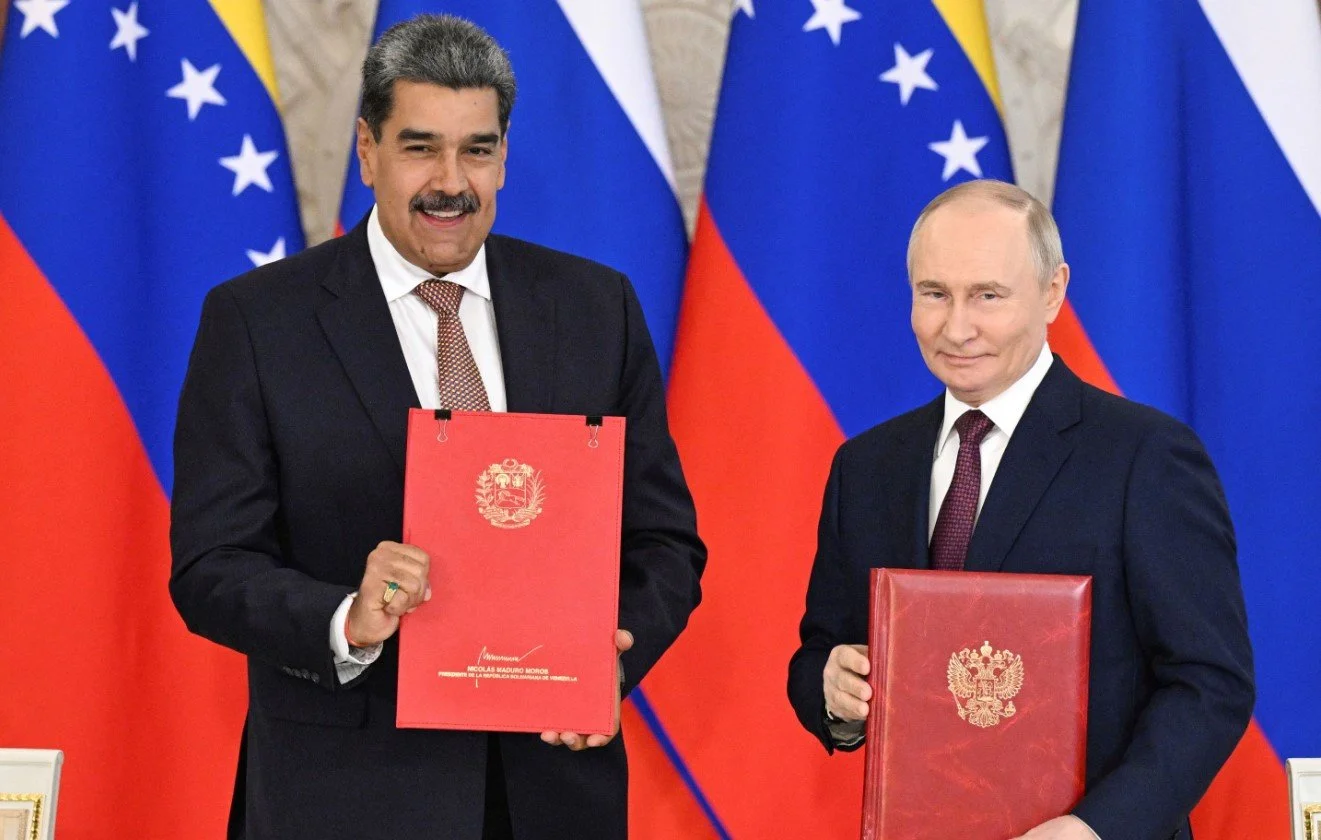
In May 2025, Russia and Venezuela signed a new strategic partnership in which they agreed to promote joint energy initiatives within OPEC+ and the Gas Exporting Countries Forum. They also agreed to cooperate in the exploration and development of new Venezuelan oil and gas fields, and in the expansion of their oil trade. Beyond energy, they agreed to closer cooperation in the United Nations, in arms control, and in joint opposition to unilateral sanctions.
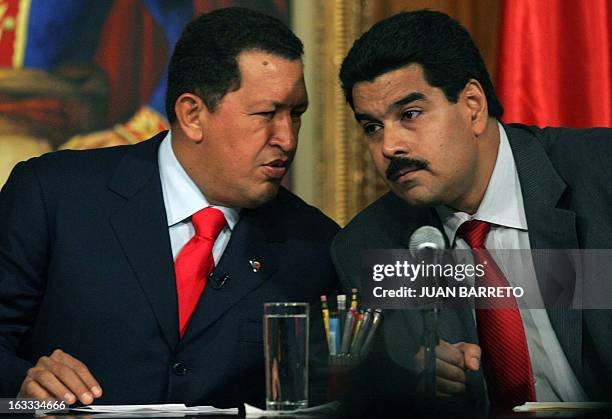
Hugo Chavez, left, and Nicholas Maduro, right.
Moral Legitimacy
Operation Absolute Resolve gives Russia an opportunity to home in on its anti-American rhetoric in the Global South. Following the operation, the Russian Foreign Ministry condemned the “armed aggression” of the US against Venezuela, reaffirming Russia’s solidarity with Venezuela and calling for Venezuela, and Latin America overall, to be “guaranteed the right to independently determine its own fate, free from any destructive—let alone military—interference from outside.” Deputy Chairman of the Russian Security Council Dmitry Medvedev denounced the American actions as a “breach of international law.” Even before the ousting of Maduro, the Russian representative to the United Nations, Vasily Nebenzya, lambasted the US military build-up around Venezuela as a “neocolonial approach.” If one can look beyond the laughable hypocrisy of these statements, Russia’s strategy of appealing to the Global South will emerge. Russia is taking advantage of Trump’s brazen intervention in Venezuela to remind countries of the Global South of their not-too-distant past as subjects of American domination, with the goal of drawing them into Russia’s anti-American sphere.
Additionally, the US’s blatant meddling in another country’s affairs allows Russia to justify its war in Ukraine by placing itself on equal moral footing with the US and its European allies. Dmitry Medvedev quickly noted the “double standards” of European leaders, who reacted mildly to the operation, likely to avoid offending Trump and further straining the NATO alliance. If the US can use military force to determine the nature of its “backyard,” why can’t Russia do the same? The perception of the world as great powers’ “backyards” is symptomatic of the resurgence of the spheres-of-influence thinking which defined the Cold War. If Latin America is in the United States’ perceived sphere of influence, as it has been for over 200 years, and if powers hostile to the United States (like Venezuela and its allies, including Russia) can be purged from its sphere of influence with no impunity, then the same can be said for Russia and its perceived sphere of influence in Ukraine and even Eastern Europe more broadly. Just as the United States decided that Maduro was an illegitimate leader, so, too, can Russia decide that Zelensky is an illegitimate leader. Both countries can therefore feel free to dispose of them, by force if necessary. This undermining of modern-day international norms is a victory for Russia as the war with Ukraine drags into its fifth year.
Cracks Showing
At the same time, the speed and apparent ease of Trump’s Venezuela operation highlights Russia’s inability to operate with the same power in Ukraine. This is a humiliation for Putin echoed by several pro-Kremlin analysts and political figures. Moreover, the fall of the Maduro regime not only cost Putin an ally—a particularly visible one in America’s backyard—but also showed the world that Russia is an unreliable partner in times of crisis. Besides generic words of condemnation and limited military support, Russia stood by as the US pressured Venezuela for months. This passive behaviour mirrors Russia’s lack of support to the Assad regime in Syria when it was overthrown in December 2024, and to the Iranian regime during its war with Israel in June 2025. Coming for the third time in thirteen months, Russia risks establishing an unwilling pattern of leaving its allies to confront crises alone.
Moreover, in light of Trump’s statements that he will “run” Venezuela and take control of its oil industry, Russia stands to lose potentially billions of dollars in exports and exploration rights. Russia’s current war economy is dependent on oil revenue, so these losses will not only harm Russia’s economy, but also its war effort in Ukraine. This is an especially pressing concern, as the Trump administration has demanded that Venezuela’s former vice president and now interim president, Delcy Rodriguez, end oil sales to all US adversaries.
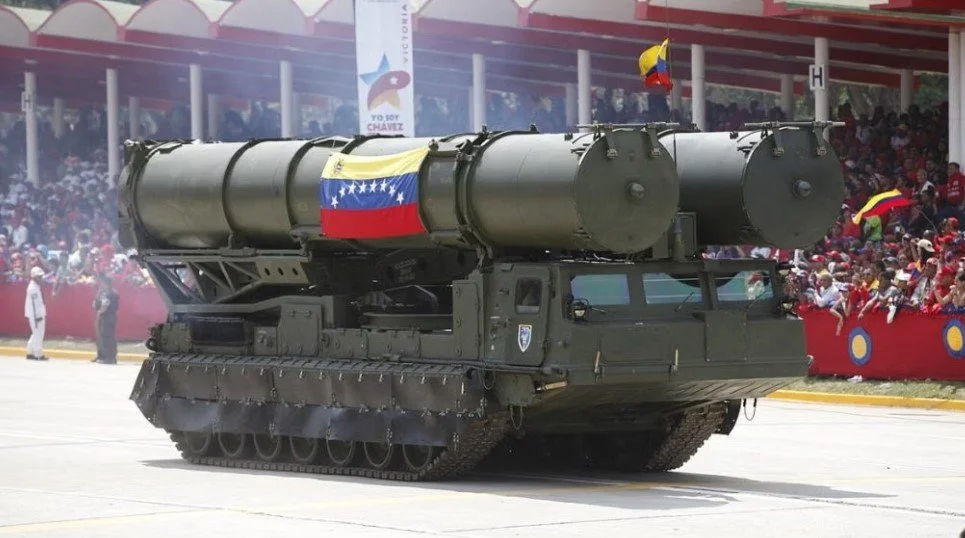
Russian S-300 air defence system in use by the Venezuelan military.
Key Players and Stakeholders
Russia: Russia seeks to maintain its access to Venezuelan oil while also leveraging the crisis to gain advantage in the war with Ukraine. Indeed, Russia could use the American intervention in Venezuela to justify Russia’s war in Ukraine. Moreover, by framing the intervention as “neocolonialism,” Russia is appealing to the Global South and strengthening its status there. At the same time, Russia’s war economy relies heavily on oil exports, so damage to Russian access to Venezuelan oil may weaken its war effort in Ukraine. Moreover, this is a blow to a Russian ally just a year after the fall of the Assad regime in Syria and a few months after Russia failed to come to the aid of yet another allied regime in Iran in its war with Israel.
Venezuela: Shortly after Maduro’s capture, Trump declared that the US will “run” Venezuela. The shape of this new system is still unclear, but Trump and Secretary of State Marco Rubio have in recent days begun to clarify what the post-Maduro era in Venezuela could look like. Delcy Rodriguez was hostile to the United States in the days immediately following the US operation (there was even talk that she had fled to Moscow). Since then, however, she has stated that she will prioritise “balanced and respectful international relations” with the US. The Trump administration’s top priority appears to be gaining access to Venezuela’s oil resources, rather than allowing Venezuela to hold democratic elections. For Russia, then, this means that for the foreseeable future, Venezuela will remain dominated by American power and will no longer be a viable ally.
United States: The Trump administration stands to become deeply enmeshed in regime change in a foreign country, which has historically become extremely messy for the US (not to mention for the given country). This means that the Trump administration will have less time to focus on other areas of foreign policy, such as Russia’s war with Ukraine. At the same time, this move will be highly lucrative for the US as it takes control of Venezuela’s oil fields. What currently appears to be a “temporary protectorate” in Venezuela has the potential to become an entrenched system of spheres of influence, with the US pushing the influence of any other country out of the Western Hemisphere.
Ukraine: American actions in Venezuela may endanger the Ukrainian war effort, as brazen American intervention in Venezuela legitimizes similar Russian intervention in Ukraine. The US claimed that Maduro was an illegitimate ruler just as Russia claims that Zelensky is. By reviving “spheres of influence” thinking through the “Trump Corollary,” Trump’s actions have implied that, just as the US is allowed to dominate its “backyard,” so Russia is too. Moreover, because the American operation highlighted Russian weakness by contrast, Putin may be driven to intensify the war in Ukraine. Zelensky suggested that the American operation sent a message to other autocrats (read: Putin), saying that “if you can do that with dictators, then the United States knows what to do next,” but this seems next to impossible.
Europe: European leaders have refrained from criticising Trump’s actions in Venezuela. German Chancellor Friedrich Merz wrote on X that US intervention was “complex” and that Maduro had “led his country into ruin.” French President Emmanuel Macron similarly stated that the Venezuelan people could “only rejoice” at Maduro’s ouster and did not mention the US. Ukraine and NATO are a higher priority to them than Venezuela, and they likely do not want to further alienate Trump, who is necessary to both of those priorities.
China: China is the primary purchaser of Venezuelan oil, the most immediate impact on China of US control over Venezuela is the disruption of its energy supply chain. After the capture of Maduro, Trump stated that the US may sell Venezuelan oil to China in “much larger doses” than Venezuela could with its crumbling infrastructure, but the terms of this sale are unclear and are unlikely to be favorable to China. At the same time, the “Trump Corollary” could suggest to China that the US would not intervene if China invades Taiwan, and legitimises such an invasion, as for Russia in Ukraine.
Greenland: The “Trump Corollary” does not bode well for Greenland, which Trump has repeatedly expressed interest in annexing since he took office in January 2025. Just as the American intervention in Venezuela was framed as a “national security” necessity, so too is the annexation of Greenland. In contrast to their passive reactions to the Venezuela operation, European leaders have been outspoken about their opposition to Trump’s ambitions in Greenland, even sending a small military deployment to the island. Meanwhile, Russia has been capitalising on Trump’s increasingly aggressive moves on Greenland to mock European weakness, on the one hand, and to accuse NATO of militarising the Arctic on the other.
Latin America: Latin American leaders have condemned Trump’s actions, including Brazil, Colombia, and Mexico. The capture of Maduro and Flores sends a message to other Latin American leaders that it is in their interest to bend to Trump’s will, lest they face a similar fate. There is also the danger of regional instability, particularly if the instability in Venezuela leads to further increased migration. The risk is especially significant for Colombia, which shares a long border with Venezuela, and Cuba, which had a close partnership with Maduro’s government and has a lot to lose in terms of highly subsidised oil and is currently on high-alert due to their government potentially being next.
Military, Economic, and Social Dimensions
Military: The Russia-Venezuela strategic partnership agreement of May 2025 did not stipulate that Russia would come to Venezuela’s defence militarily, showing the limits of this alliance. Russia does not receive weapons or troops from Venezuela like it does from Iran and North Korea, meaning that a lost partnership with Venezuela would not do as much material damage as the loss of those other partnerships. Still, the loss of Maduro’s Venezuela means a loss of naval port calls, intelligence cooperation, and arms maintenance agreements for Russia. Furthermore, Venezuela offered Russia a relatively low maintenance partner in the Western Hemisphere, a highly visible presence in America’s backyard, making this a largely symbolic loss for Russia in military terms.
Economic: The primary economic threat to Russia regarding Venezuelan oil is that the US may use its new control over that oil to undercut Russian exports to China, which is one of the main buyers of Russian oil. Moreover, the overthrow of Maduro’s government makes the fate of Russia-Venezuela trade deals uncertain. Russia owns exploration and export rights to two of Venezuela’s gas fields, as well as billions of dollars in rights to proved but untapped reserves of Venezuelan crude. In November 2025, Venezuela approved a 15-year extension of the partnership between its state-owned oil company PDVSA and the Russian state-owned oil company Roszarubezhneft, with a total investment of about $616 million. That same month, an intergovernmental Russian-Venezuelan Commision announced a plan to expand their trade to $400 million by 2030. They also suggested that there was potential for using Russian nuclear technologies to boost Venezuela’s agricultural, industrial, medical, and educational sectors. In his statement on Saturday, shortly after the capture of Maduro, Trump said that the US would now sell Venezuelan oil to Russia. A few days later, however, American officials stated that they expected Delcy Rodriguez to stop selling oil to countries hostile to the US. It is therefore still unclear what the extent of Russian economic losses will be.
Social: Operation Absolute Resolve may damage Russia’s status in the Global South. Russia has labeled American actions as “neocolonialism” and its criticism of American “unilateral sanctions” on Venezuela is a thinly-veiled criticism of sanctions on Russia and appeals to countries which suffer secondary sanctions. However, such rhetoric may not be enough to counter Russia’s loss of face with its allies and partners in the Global South, which see Russia’s inability to defend its ally Venezuela against this so-called neocolonialism.
Opportunities and Risks
Opportunities for Russia: There are four main opportunities for Russia in the wake of Maduro’s ousting. First, leveraging on “spheres-of-influence” thinking, Russia can use American actions to justify its own actions in Ukraine. Second, Russia can strengthen its status in the Global South as a bulwark against American “neocolonialism.” Third, Russia can use the US’s preoccupation with Venezuela to make gains in Ukraine before peace negotiations continue. And finally, Russia can form new alliances in Latin America by exploiting potential divisions between the US and Latin American leaders who condemned the American operation.
Risks for Russia: There are four main risks for Russia.
First is the financial damage from the loss of oil revenue, which will be especially challenging to Russia’s war economy. These losses may come from the crumbling of existing deals with Venezuela, stranded assets from exploration rights, disruption of Russia’s shadow fleet, and the US selling Venezuelan oil to China and undercutting Russia’s oil market there.
Russia’s strategic displacement through the loss of an ally in the Western Hemisphere. The fall of Maduro’s Venezuela may also lead to the decline of Cuba, another Russian ally in the region.
Russia’s inability to help Maduro risks projecting weakness. This is the third time in the last thirteen months that Russia has failed to come to the aid of an allied regime, after the Assad regime in Syria in December 2024 and Iran in June 2025.
The United States will have more diplomatic and economic leverage over Russia in negotiations over Ukraine because of Russia’s overall weakened geopolitical position, combined with the confidence boost that the successful Venezuelan operation surely gave Trump.
Potential Scenarios
Best-case scenario for Russia: The best-case scenario for Russia is that it and the United States mutually acknowledge each other’s “spheres of influence.” In this case, the US would put less pressure on Russia to reach a deal with Ukraine as long as Russia accepts the US-led order in Venezuela. This would strengthen Russia’s claims to be a great power alongside the US and China, and signal a return to a multipolar world as in the Cold War.
Mid-case scenario for Russia: An acceptable scenario for Russia would be that it reaches a “pragmatic” deal with the US, by which Trump allows Russia to maintain some economic assets in Venezuela in exchange for some Russian concessions in Ukraine peace talks and acquiescence to the new Venezuelan order. Considering its non-intervention in defence of Venezuela, this is the path that Russia appears to be preparing for. Russia is experienced in pragmatic adjustments to delicate geopolitical circumstances, as with the aftermath of the Assad regime’s collapse. Russia’s strategic priority remains Ukraine, so its primary interest in Venezuela is protecting its economic investments, which are critical to its wartime economy, and to not lose leverage in peace negotiations by angering Trump. Moreover, as Maduro’s vice president, Delcy Rodriguez maintained ties with Moscow, even receiving the Order of Friendship award from Putin in 2024. The order that seems to be taking shape in Venezuela is therefore one which Russia can adjust to quite straightforwardly.
Worst-case scenario for Russia: The worst-case scenario for Russia would be that the US uses its momentum to further squeeze the shadow fleet, crippling Russia’s oil revenue. US-Russian tensions would escalate and spill over into Ukraine peace negotiations, where Russia would be pressured in a way that Trump has not done as of yet. The delicate balance of powers in Venezuela could collapse, Delcy Rodriguez’s government may topple, and a staunchly pro-American government may take its place.
Policy Recommendations
This is the ideal opportunity for the United States to block Russian and Chinese influence in Latin America, and in the Western Hemisphere more broadly. The US can capitalise on Venezuelan oil to push Russia out, and establish a pro-American regime in Venezuela. However, that would polarize the world even further, and it could entrench Russia’s occupation of Ukraine and even enable a Chinese invasion of Taiwan.
Instead, this should be taken as an opportunity to create stability. Trump’s actions in Venezuela could be interpreted in two conflicting ways: either as a message of strength that will discourage Russia (and China) from intervening in Latin America, or as a sign of the chaos in American foreign policy. In order to project strength rather than chaos, the US should approach regime change in Venezuela in a way that at least signals a long-term plan.
Russia, meanwhile, likely wants to avoid crossing Trump at a time when Ukraine peace negotiations are ongoing. It is therefore in the interest of both parties to move forward in a relatively predictable, pragmatic manner, rather than plunge the region into further turmoil.
Conclusions
Moscow stands to gain significant geopolitical advantage if the return of “spheres of influence” thinking strengthens its claims to Ukraine. At the same time, Russia may be weakened economically because of the loss of oil revenue and politically because of the loss of an ally. What happens ultimately depends on who replaces Maduro as leader of Venezuela, what form of government takes shape there, and what actions the “Trump Corollary” inspires Trump to take next. For now, it seems that Delcy Rodriguez is willing to work with the US, but she is not the worst leader for Venezuela to have in Russian eyes, and the balance of powers in Venezuela remains precarious. It is best for Russia to remain quiet now and let events in Venezuela play out before deciding on a course of action.

Written by Noam Bizan
Noam is an analyst for Geopol and a PhD Researcher at the University of Cambridge