
The Disarmament of Hezbollah & the Potential Repercussions for the Wider Region
December 29, 2025 - Written by Aydin Dezfouli
Introduction
Influenced by the Islamic Revolution, founded in 1982 and armed and trained by the clandestine wing of Iran’s Islamic Revolutionary Guard Corps, also known as the Quds Force, Hezbollah has grown to be the world’s largest non-state paramilitary force. Designated as a terrorist organisation by the U.S., Canada, UK, Germany, Netherlands, Gulf Cooperation Council (GCC), Hezbollah successfully ended the Israeli occupation of Lebanon and reclaimed Lebanese integrity. In other theatres of conflicts such as in Syria, its experienced fighters have demonstrated that Hezbollah is a formidable force across the broader region.
This report examines the recent setbacks to Hezbollah by analysing the ceasefire agreement that has created the conditions for their disarmament. The theme of this report focuses on security, politics, and welfare in Lebanon and the wider Middle East, reaching a conclusion on the repercussions of a total disarmament of Hezbollah for the region as a whole.
Contextual Analysis
Disarmament
On 27 November 2024, the United States and France facilitated negotiations that produced the terms of a ceasefire agreement between Lebanon and Israel.
The agreement set out several key provisions. The Israel Defense Forces were required to withdraw from southern Lebanon within a 60-day timeframe. Hezbollah, for its part, was instructed to comply with United Nations Security Council Resolution 1701, which mandates that all non-state armed actors redeploy north of the Litani River. In addition, UN peacekeepers, together with 5,000 personnel from the Lebanese Armed Forces, were to be deployed to monitor the situation and prevent any renewed exchange of fire.
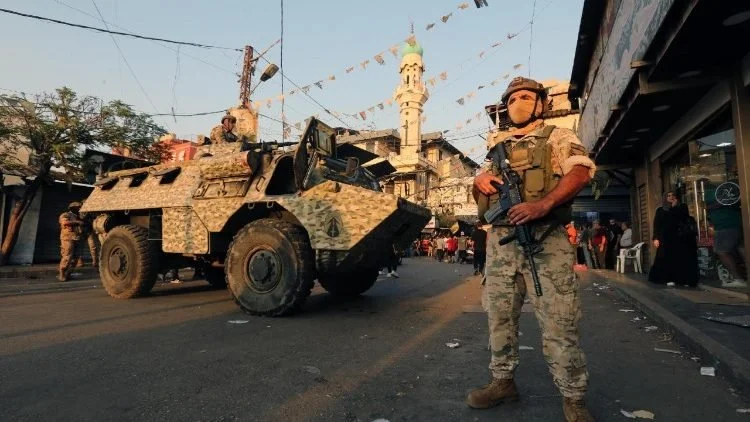
President Joseph Aoun, through the Government’s “Homeland Shield Plan,” instructed the Lebanese Armed Forces (LAF) to begin the disarmament of non-state actors (Hezbollah) from the area south of the Litani River extending up towards the Beqaa Valley. Under this directive, the LAF is required to place all remaining stockpiles of weapons and military equipment under state control by the end of 2025. According to US military assessments, more than 10,000 rockets and 400 missiles have already been deactivated, and approximately 85% of the territory south of the Litani River has been cleared of Hezbollah fighters.
Security
Prior to the assassination of Hezbollah’s Secretary-General, Hassan Nasrallah, in September 2024, the “Party of God” had, over the course of four decades, expanded from a small militia into one of the world’s largest non-state paramilitary forces, headquartered in Dahieh, Beirut. With an estimated force of between 40,000 and 50,000 soldiers, who were equipped with thousands of rockets, drones, and also advanced weapons systems. Hezbollah also developed an independent intelligence capability operating across Lebanon and the wider Middle East.
Following the 34-day war in 2006, UN Security Council Resolution 1701 established the terms of a ceasefire: a full withdrawal of Israeli forces from southern Lebanon, an end to the naval blockade, and a halt to all Israeli military operations within Lebanon. Despite extensive airstrikes that reduced much of Dahieh to rubble, the Israel Defense Forces struggled to counter Hezbollah’s decentralised guerrilla tactics. Although periodic tit-for-tat border incidents continued, Israel remained cautious about provoking major retaliation, and a fragile form of stability persisted along the frontier for more than two decades.
The recent disarmament efforts targeting Hezbollah have, however, altered Lebanon’s security landscape. Israel has been able to carry out strikes deep into Beirut with relative freedom and has not fully withdrawn from southern Lebanese territory as stipulated under UNSCR 1701. While President Joseph Aoun has expressed frustration, Israel has crossed the UN-demarcated Blue Line and started constructing a 75-mile reinforced wall, asserting an unrecognised self-declared buffer zone. This development not only contravenes international legal norms but also undermines the sovereignty and territorial integrity of the Lebanese state. President Emmanuel Macron has criticised Israel’s actions, yet Washington has remained largely silent on the matter.
Hezbollah has also played a significant role in regional conflicts. In 2013, its fighters crossed into Syria and helped break the Islamic State’s siege of the ancient Aramaic Christian town of Maaloula. Throughout the Syrian civil war, Hezbollah provided crucial support to Assad’s forces, gaining substantial battlefield experience while inflicting heavy losses on Islamic State and the al-Nusra Front (an al-Qaeda affiliate). Although this intervention was deeply controversial within Lebanon, Nasrallah justified it as necessary to prevent the spread of ISIS into Lebanon and the broader Middle East.
Today, with ISIS sleeper cells still active in northern Syria and Iraq, and instability growing across the region, the emergence of a new insurgency could unfold without Hezbollah as a counterweight. This raises the risk of unrestrained sectarian conflict spilling across the Middle East and into Lebanon itself. Hezbollah has long served as a strategic external-security asset for Tehran. The region has been locked in a delicate balance of power between Israel’s advanced military capability and Iran’s regional network of allies. However, after the events of the 12-day war in June 2025, Israel increasingly appears less concerned about a major offensive from Hezbollah, suggesting that the longstanding deterrence dynamic that Iran has depended on may be shifting.
Politics
Lebanese politics has long been divided between two major blocs. The “14th March Alliance”, composed primarily of Sunni representatives associated with Rafiq, Saad Hariri and Maronite Christian figures such as Samir Geagea of the Lebanese Forces Party, traditionally enjoyed strong financial support from Saudi Arabia. In contrast, the “8th March Alliance”, led by Hezbollah and the Amal Movement (both Shia parties) and aligned with the Christian faction of former President Michel Aoun, has maintained close ties with Iran and, historically, with the Assad regime in Syria. These political divisions operate within the framework of Lebanon’s confessional system, a political structure dividing power among its recognised religious sects established under the French Mandate and enshrined in its written constitution.
Hezbollah’s ideological foundations are deeply rooted in the struggle for Palestinian people to have statehood and fundamental rights. Its political manifesto closely aligns with the principles of the Islamic Republic of Iran, framing its mission as part of a broader struggle for the liberation of Palestine. For decades, Palestinian refugees in southern Lebanon have benefited from the protection provided by Hezbollah, despite underlying Shia-Sunni sectarian differences. Nasrallah frequently described Hezbollah as being at the forefront of Palestinian resistance.
Following the attack of 7th October, 2023, the subsequent escalation of conflict in Gaza triggered intense cross-border exchanges between Hezbollah and Israel. Hezbollah launched missiles and drone strikes into northern Israel, prompting heavy Israeli retaliation in the form of extensive airstrikes on southern Lebanon and parts of Beirut. These strikes resulted in the killing of several senior Hezbollah commanders and significantly weakened elements of its leadership.
In the aftermath of these events and the weakening of Hezbollah, regional solidarity with Palestine has become largely rhetorical, with most Arab governments issuing verbal condemnations but avoiding direct intervention on their behalf. The gap between public sentiment and state policy has grown increasingly apparent, as geopolitical constraints and domestic pressures limit the willingness of Arab states to take more decisive action in the face of Palestinian suffering.
Social Welfare
Hezbollah’s welfare program functions as a parallel system of governance in Lebanon, providing essential services in areas where the state has long been weak. Funded primarily by Iran, religious donations, and affiliated charities, this network supplies healthcare, education, social assistance, and reconstruction aid to communities in southern Lebanon, Beirut and Beqaa Valley. Through institutions such as the Social Welfare Association and the Islamic Health Society, Hezbollah offers subsidised medical care, financial support for poor families, and social services for widows, orphans, and the families of fighters.
The organisation’s reconstruction arm, Jihad al-Binaa, became particularly prominent after the 2006 war, rebuilding homes and infrastructure far more quickly than the Lebanese state. Hezbollah also operates schools, vocational programs, and scholarship initiatives that reinforce both social mobility and political loyalty. Its Martyrs’ Foundation provides long-term support to the families of deceased or injured fighters, strengthening ties between the movement and its core supporters.
This extensive welfare network has been crucial to Hezbollah’s popularity within Lebanon’s Shiite community. By filling gaps left by the country’s fragmented and underfunded public sector, Hezbollah positions itself as a reliable provider of security and services. Critics argue that this parallel system entrenches sectarian division and undermines state institutions, but its effectiveness has helped sustain Hezbollah’s political influence. Overall, the welfare program remains a key pillar of the group’s power, embedding it deeply within Lebanon’s social and political landscape.
Challenges
The United States, United Kingdom, Saudi Arabia, the United Arab Emirates, Jordan, and several other United Nations member states have designated Hezbollah as a terrorist organisation. In connection with the Islamic Revolutionary Guard Corps, the group has been accused of involvement in the 1983 US Marine barracks bombing in Beirut and the 1994 AMIA bombing in Buenos Aires. Additional allegations concerning narcotics trafficking, money laundering, and hostage-taking have also been levelled against the organisation.
However, across much of the Arab and wider Muslim world, Sayyid Hassan Nasrallah has been viewed as a symbol of resistance to ongoing Israeli aggression and as a central figure in ending Israel’s long occupation of southern Lebanon, while also remaining committed to the cause of Palestinian solidarity. At the same time, Hezbollah faces sustained criticism for acting as a proxy for specific Iranian interests, particularly within the Arab world.
Public opinion within Lebanon reflects this stark divide. According to The Lebanon Report, approximately 30% of the population expresses approval of Hezbollah, while 55% reports having “no trust” in the organisation. This breakdown varies sharply along sectarian lines: trust among Shi‘ites stands at around 85%, compared with 9% among Sunnis, 6% among Druze, and 6% among Christians. This widespread distrust is closely tied to Lebanon’s entrenched sectarian divisions, its ongoing economic collapse, and Hezbollah’s involvement in regional conflicts.
Key Players
Iran
Since the 1980s, Iran has supported Hezbollah through substantial financial assistance, often estimated at up to $700 million annually, alongside weapons transfers, military training, and strategic guidance provided by the Islamic Revolutionary Guard Corps (IRGC). This sustained backing has enabled Hezbollah to develop into one of the most powerful non-state military actors in the region and a central instrument of Iranian influence, serving to project power, deter Israel, and counter U.S. presence in the Middle East.
In September 2025, senior Iranian official Ali Larijani undertook a state visit to Lebanon, seeking to establish a new framework for security cooperation between Tehran and Beirut in anticipation of a potential post-Hezbollah transition. In response, President Aoun asserted that Lebanon would not permit any foreign interference in its internal affairs, underscoring the government’s effort to reassert state sovereignty amid evolving regional dynamics.
Israel
After the October 7th attack, Israel has pursued a broad military campaign aimed at dismantling Iranian proxies across Gaza, Syria, Yemen, and Lebanon. Despite a ceasefire initiative supported by the United States and France, Israeli forces have remained in southern Lebanon in violation of UN Security Council Resolution 1701, which mandates their withdrawal. As bombardment of Beirut continues, Israel appears determined to target remaining Hezbollah commanders while simultaneously constructing a buffer zone beyond the Blue Line and into Lebanese territory.
Lebanon
The Government of Lebanon has expressed its commitment to disarming all non-state armed groups as part of a broader effort to reassert state sovereignty and restore the central monopoly on the use of force. Although the Lebanese Armed Forces (LAF) have formally been tasked with the responsibility of disarming Hezbollah, their capacity to do so remains severely constrained, particularly given the LAF’s limited resources, internal divisions, and inability to confront major external security threats.
Opportunities and Risks
Opportunities:
The disarming of Hezbollah would enable the Lebanese government to function more fully as a legitimate state authority, with the Lebanese Armed Forces taking sole responsibility for national security matters.
Hezbollah’s recent setbacks have also significantly curtailed Iranian influence in Lebanon - continued disarmament of Hezbollah could potentially sever the link between Tehran and the east Mediterranean.
Lebanon has started to attract foreign investment once again and is taking its first steps towards recovery from the 2019 economic crisis.
Risks:
The Lebanese Armed Forces do not possess the manpower capabilities to address both external and internal threats effectively.
Lebanon’s sovereignty is now under increasing strain, as continued bombardment and further territorial encroachment violate international law by Israel. This can lead to the delegitimisation of the Lebanese government, which is experiencing historic spike in popularity after years of distrust, and delegitimisation fears could become a real issue for the present government, as Israel’s continued occupation of South Lebanon after ceasefire agreements will make the disarmament process of Hezbollah even more challenging.
Israel’s position of military superiority is now largely unchallenged and this has wide repercussions.
Conclusion
Despite being designated as a terrorist organisation, Hezbollah’s presence has helped sustain stability along Lebanon’s northern and southern borders. It has played a key role in ending long standing foreign military occupation and in reclaiming aspects of Lebanon’s sovereignty. The group has also fulfilled its commitment to providing goods, services, and security in areas where the government has long struggled to meet citizens’ needs, particularly among the Shia and Palestinian communities . In the broader regional context, Hezbollah has demonstrated its willingness to confront instability in Syria, while positioning itself within the balance of power between Tehran and Tel Aviv. In a region marked by chronic volatility, the disarmament of Hezbollah would have significant repercussions for both Lebanon and the wider Middle East, creating uncertainty in regional geopolitics.

Written by Aydin Dezfouli
Analyst on the MENA Research Desk