
Serbia at a Turning Point: Student Protests and the Crisis of the Status Quo
December 18, 2025 - Written by Christian Naso
Introduction
The collapse of the Novi Sad railway station canopy on 1 November 2024, which killed sixteen people, ignited a wave of student protests amid widespread suspicions of corruption linked to the station’s refurbishment. What began as a local outcry soon expanded across the country, evolving into a movement that is now destabilising a regime previously perceived as solid and immovable.
In the following weeks, hundreds of thousands of citizens nationwide have continued to demonstrate incessantly, demanding an end to a political system rooted in corruption, patronage networks, and state-controlled medias.
This protest movement, the largest the country has witnessed in recent decades, draws its power from its character: peaceful, non-partisan, and decentralised. Born within universities, it has spread to towns and rural communities alike, generating a nationwide sense of solidarity that the authorities had not foreseen.
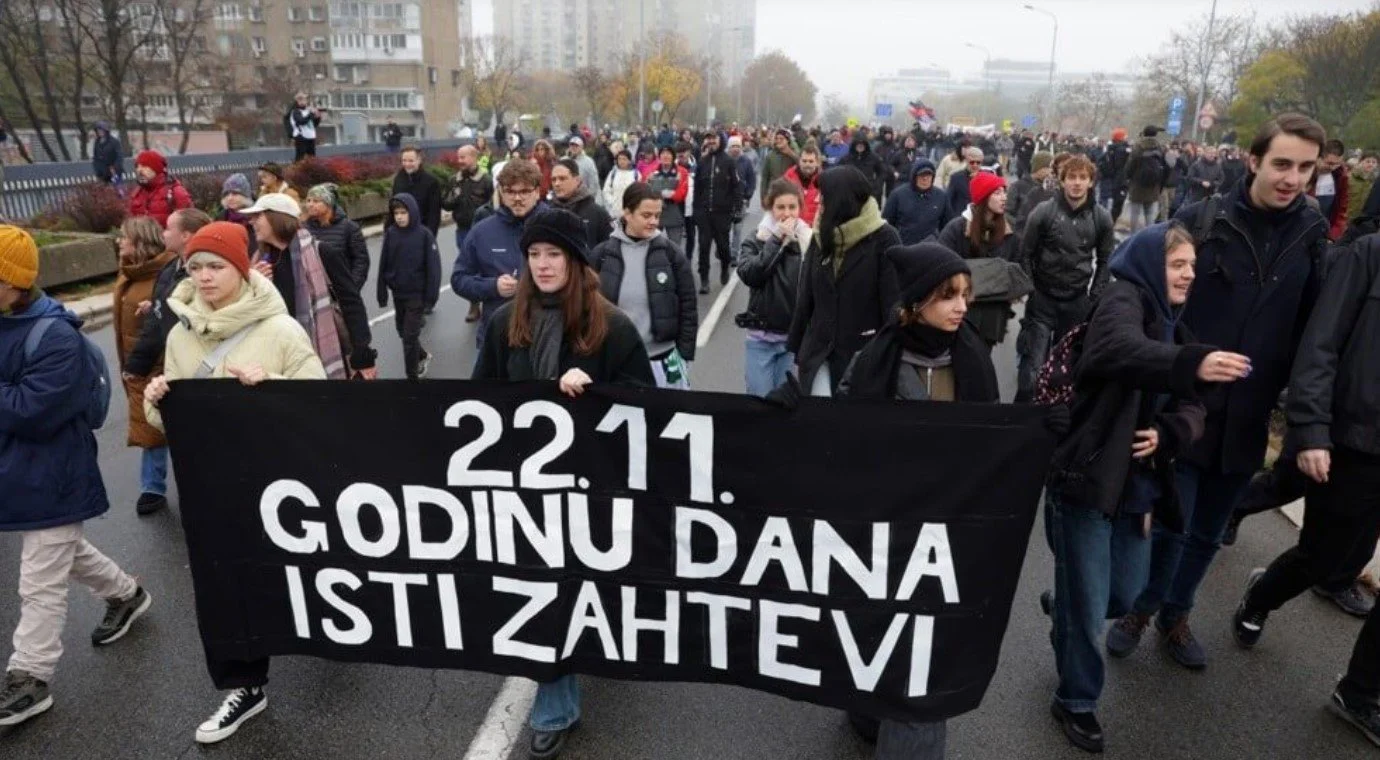
The student movement represents the most significant popular mobilisation since the fall of the Milošević government in the early 2000s. Symbolically accompanied by the students of that era, today’s youth have launched a new wave of demonstrations. The most recent event took place on 1 November 2025, when student marches crossed the country from every direction to converge on Novi Sad in northern Serbia. Tens of thousands of people participated in the march, turning the protest into a moment of national unity unseen since the post-Milošević transition.
The Background
The protests began after the collapse of the roof at Novi Sad’s train station on November 1, 2024, which killed 16 people. Public anger quickly grew because the station had just been reopened after renovations. Many believed the construction work was rushed and poorly supervised, reflecting widespread corruption in public contracts under President Vučić.
What started as small memorial gatherings soon became the largest protest movement in modern Serbian history, featuring strikes, marches, and road blockades. Academics criticised the ruling party for refusing to call new elections, one of the central demands of the movement.
Furthermore, many citizens hold the government responsible for the tragedy, linking it to a badly managed state renovation project, even though officials deny responsibility.
Reports of heavy-handed police tactics fueled public anger, eventually leading President Aleksandar Vučić to try to ease tensions by pressuring Prime Minister Miloš Vučević and his cabinet to step down.
On March 15, 2025, Belgrade saw one of the largest demonstrations in the capital, with estimates of 700,000 people. Central authorities responded with force, leading to arrests and violent clashes: a pattern that has increasingly defined the government’s approach over the past year.
In preparation for the 1st of November’s demonstration, students have spent 16 days walking across the country, one day for each of the people who died; and authorities suspended all rail services on, officially citing a bomb threat. However, media outlets reported that the move was likely intended to stop people from traveling to the demonstrations.
What started as a call for accountability over a tragedy linked to government failures has, over the past year, grown into a nationwide protest movement.
Internal and External Actors
Aleksandar Vučić and NSN
Aleksandar Vučić, president of Serbia, founded the Serbian Progression Party (SNS) and won the most votes in the 2012 elections and formed a coalition government with the Socialist Party of Serbia.
Vučić became first deputy prime minister and the party’s president. Although he did not initially hold the position of prime minister, he quickly became the most influential political figure, using his leadership of the country’s strongest party to dominate government decision-making.
This influence built on his long political career. He had previously served as minister of information in 1998 under the government of Mirko Marjanović, a role he held until the fall of Slobodan Milošević in 2000.
The Students
Since the start of the Vučić government in 2012, the country has seen repeated waves of public protests. The current movement has united a broad range of social groups, crossing different parts of society rather than simply reflecting a generational conflict.
Firstly, Serbian Gen Z students, the country’s future professional and civic leaders, see the current state of Serbia, and the wider Western Balkans, as one that leaves them with no choice but to leave. Many feels trapped in a society seen as deeply corrupt and nearly impossible to reform from within.
Student activism has also helped reconnect the country on a geographical level. Marches and demonstrations have spread from the northwest, through Belgrade, down to southern cities such as Niš and Novi Pazar, where students were welcomed and supported by local communities at every stop.
Opposition Parties
Opposition support and take part in the student protests, but they do not control them. They are careful not to present themselves as leading the movement, since doing so could allow the government to portray the demonstrations as just another political power struggle. Instead, the student movement represents a new type of social and ideological conflict, not merely a political one, which the Vučić regime would otherwise try to exploit.
European Union
Serbia was granted EU candidate status in 2012 and began accession talks the following year. European Commission President Ursula von der Leyen recently urged Vučić and the Serbian government to take concrete steps toward making EU membership a reality, by joining the EU when it comes to Russia’s sanctions and a major effort in guarantee the rule of law within the country. Despite of a timid European approach, the European Commissioner for the Enlargement Marta Kos openly criticised Serbian’s government reaction, whereas Vučić ordered faster reforms and pledged elections within a year, while denouncing the situation as “blackmail”.
Russia
Russia has publicly backed Vučić as he faces large anti-corruption protests, defining the protest a colourful revolution backed up by the Western Powers.
Despite Putin’s support, Serbia has condemned Russia’s 2022 invasion of Ukraine, and President Vučić has met with Volodymyr Zelenskyy several times. However, Belgrade has refused to join Western sanctions, insisting on maintaining neutrality despite international pressure. Recently, relations with Moscow have become strained after Russia’s intelligence service accused Serbia of indirectly selling ammunition to Ukraine through intermediaries.
The Status Quo: students protest and the implication on Serbia’s foreign policy
Students are calling for the dismantling of the “Vučić system,” demanding early elections and greater transparency in economic, political, and social processes. These goals are closely linked to the broader question of Serbia’s path toward European Union integration.
According to several observatories, the Vučić system has deeply penetrated state institutions, prioritising party interests over the public good and maintaining a high degree of centralised control. Investigations and media reports suggest that organised crime has gained influence within state structures, raising concerns that these networks could remain in place even if the current government were replaced.
Belgrade’s main goal is to delay early elections, as Vučić and his party would face a difficult challenge in trying to hold on to power. To maintain control, the government has relied on repression and a distorted political narrative, strongly supported by national media that remain fully under its influence. The government also promotes the idea of a special “Serbian Russian brotherhood” as part of a dual strategy of keeping one foot in Moscow and the other in Brussels.
Russian support is used when Serbia needs to fill gaps that the European Union cannot or will not address. At the same time, increasing Chinese investment in the Balkans is pulling Serbia further away from the values the EU expects it to embrace. In fact, China has overtaken Russia in terms of influence, while Moscow’s role has largely been reduced to offering political backing.
Policy Recommendations
In the best-case scenario, Serbia manages a controlled and peaceful political stabilisation. The government de-escalates tensions, agrees to early elections, and allows independent monitoring by domestic bodies and international observers. This would enable Serbia to reposition itself as a constructive and reliable regional actor, advancing judicial reform, political accountability, and renewed progress in the EU accession process. To achieve this outcome, the government would need to commit to transparent elections, update voter registers, ensure equal media access, and strengthen institutional safeguards to guarantee a fair and credible vote. This would also carry important foreign policy consequences: it would improve Serbia’s credibility with the European Union, signal genuine alignment with European standards of democratic governance, and reduce Belgrade’s reliance on Russia and China.
For the EU, such a scenario demands active engagement rather than distance: the European Parliament can act as the Union’s democratic voice, ensuring that the movement’s concerns are heard in Europe. The European Commission, as guardian of the accession process, can reinforce this by credibly using conditionality and targeted support to guide Serbia back onto a reformist path. If reforms stall or excessive force is used, the EU should be ready to freeze elements of the accession process; but if a genuinely democratic government emerges, it must equally be prepared to provide strong assistance to restore media pluralism, judicial independence, and institutional transparency.
By constructively engaging now, the EU has a unique opportunity to help transform the current protest into lasting institutional change, making clear that the road to Brussels runs through a truly democratic Belgrade and supporting citizens in building a freer democracy on their European path.
Written by Christian Naso
Analyst on the European Research Desk