
Syria's Re-emergence as a Regional Connectivity Hub: Geopolitical and Investment Prospects for Cross-Border Infrastructure
August 18, 2026 - Written by Oscar Bermudez
Executive Summary
Syria's post-conflict transition offers an opportunity to support long-term economic recovery through the reconstruction of regional transportation and energy infrastructure. Before the civil war, Syria served as a key transit corridor linking Iraq, Türkiye, and the Eastern Mediterranean, supporting regional trade and energy exports. More than a decade of conflict severely damaged Syria’s highways, railways, border crossings, ports, and pipeline network, disrupting regional trade and limiting cross-border transportation and energy flows.
Syria's renewed engagement with the regional and international community, alongside recent developments in the region, particularly the U.S.-Israeli conflict with Iran, has renewed interest in restoring Syria's role in regional transportation and energy networks. As concerns over the security of energy exports through the Strait of Hormuz have intensified, proposals to rehabilitate the Kirkuk–Baniyas oil pipeline, restore sections of the historic Hejaz Railway, and improve regional infrastructure, including the rehabilitation of the M45 international highway, one of the region’s main overland trade corridors linking Türkiye, Syria, Jordan, and the Gulf, have gained renewed strategic importance as part of broader efforts to restore regional connectivity.
Historical Analysis
Before the outbreak of the Syrian Civil War in 2011, Syria was largely self-sufficient in energy production and a net exporter of crude oil, with oil and natural gas revenues accounting for around 20 percent of government income. Although Syria's hydrocarbon reserves were modest compared with neighbouring Iraq, it was the largest producer of oil and natural gas among the eastern Mediterranean states. Situated at the crossroads of the Levant, Syria's geographic position and energy infrastructure made it an important regional transit state, linking Iraq's energy resources to Mediterranean export markets, while promoting regional trade and connectivity. Aside from Syria’s energy infrastructure, Syria had a well-developed transportation network that supported domestic commerce and enabled the movement of goods and energy resources across the Levant and neighbouring countries.
The outbreak of the civil war severely disrupted these transportation and energy networks, undermining Syria's role as a regional transit state. Oil fields and critical transportation infrastructure changed hands repeatedly during the war, while sanctions, conflict-related damage, and underinvestment contributed to a sharp decline in production. Domestic crude oil output fell from more than 400,000 barrels per day before the conflict to around 30,000 barrels per day a decade later. Railways, highways, ports, border crossings, and pipeline infrastructure were severely damaged, while many sections of the railway network were destroyed, looted, or dismantled and sold on the black market.
Restoration of the Kirkuk–Baniyas Pipeline
Commissioned in 1952, the Kirkuk–Baniyas oil pipeline stretched 895 kilometres from Iraq's Kirkuk oil fields to Syria’s Mediterranean port of Baniyas and had an annual transport capacity of 13.5 million tonnes of crude oil. The pipeline provided Iraq with a western export outlet to international markets while making Syria a key conduit for Iraqi oil exports to the Mediterranean. However, over several decades, the pipeline faced several interruptions due to regional political disputes and security developments; it was ultimately shut down after receiving extensive damage during the 2003 Iraq war.
Following the ouster of former Syrian President Bashar al-Assad in late 2024, Syria and Iraq held preliminary discussions on restoring the pipeline; however, these talks failed to gain significant momentum until 2026. On July 17, 2026, Iraq and Syria signed a United States-backed cooperation agreement during the United States-Iraq Business Summit in Washington aimed at reviving the project. The U.S. Department of State stated that a U.S.-led consortium would oversee the technical and financial aspects of the project, while US companies Chevron and TI Capital and Qatari firm UCC Holding announced plans to participate in the pipeline's rehabilitation. On July 26, Iraq's Council of Ministers approved a memorandum of understanding (MoU) with Syria to advance the project.
The project is estimated to cost between US$4 billion and US$8 billion and would represent one of Syria’s largest reconstruction efforts. It is expected to generate significant economic activity through large-scale construction, modernisation of energy infrastructure, and expansion of refining facilities capable of processing both Syrian and Iraqi crude oil. Construction is projected to take two to three years and require thousands of workers, with Syrian authorities requiring that operational roles be filled by Syrian personnel. Restoring the pipeline will require the installation of tens of thousands of tonnes of new pipeline, pumping stations, storage tanks, and related export infrastructure to enable crude oil exports through the Mediterranean coast.
According to the U.S. Department of State, the rehabilitated pipeline is expected to have an initial transport capacity of approximately two million barrels of crude oil per day. Beyond transporting Iraqi crude for export, Syrian officials envision using the expanded pipeline and refining infrastructure to process domestic crude oil, strengthening Syria’s energy sector while restoring its role as a regional energy transit hub.
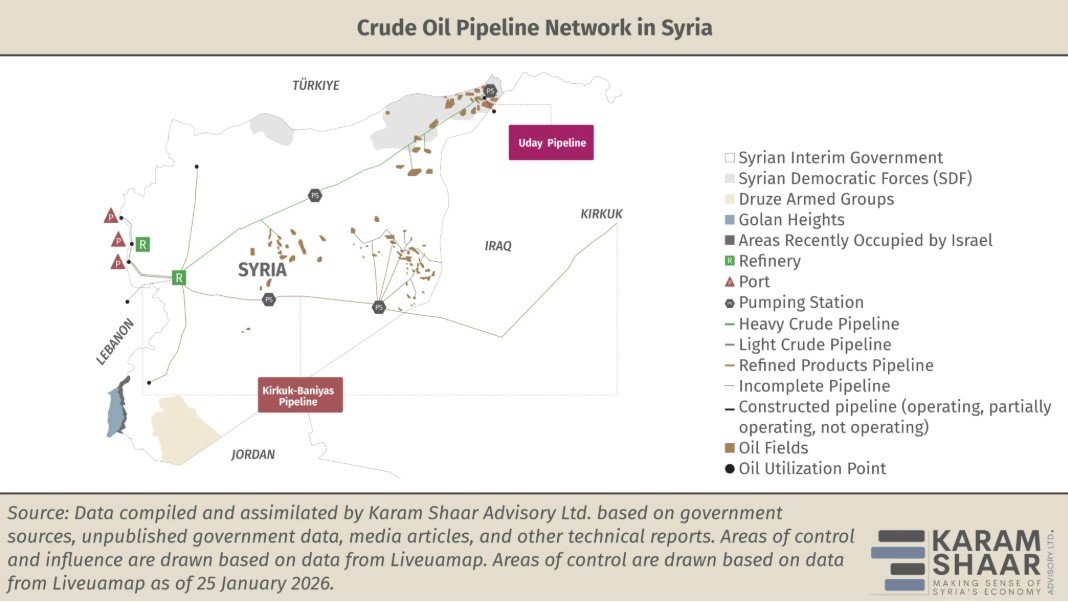
Crude Oil Pipeline Networks in Syria. Source:Karam Shaar
Reviving the Hejaz Railway: Reconnecting Regional Trade
Originally constructed during the Ottoman Empire, the Hejaz Railway connected Istanbul with Medina via Damascus, positioning Syria as the principal land corridor linking Anatolia, the Levant, and the Arabian Peninsula. Beyond facilitating the annual Hajj pilgrimage, the railway supported trade, military logistics, and the movement of goods across the region.
In April 2026, Türkiye, Syria, and Jordan signed a trilateral agreement establishing a framework to strengthen regional transport integration through cooperation on road, rail, maritime, and air transport, while encouraging private-sector investment and infrastructure development. Building on this initiative, Türkiye and Saudi Arabia signed two separate memorandums of understanding on June 10 to revive the Hejaz Railway and advance railway and logistics cooperation. The agreements include feasibility studies for a modern rail corridor linking Türkiye to Saudi Arabia through Aleppo, Damascus, and Amman, establishing a new trade corridor connecting the Gulf with Europe.
If completed, the railway would provide a continuous overland freight corridor linking Türkiye, the Levant, and the Gulf states, reducing transportation costs, shortening transit times, and strengthening regional supply chains and cross-border trade. The project would also complement other regional infrastructure initiatives, including the Iraq Development Road, the proposed rehabilitation of the Kirkuk–Baniyas oil pipeline, and the M45 international highway. Over the longer term, planners have proposed extending the corridor beyond Saudi Arabia to Oman and the Indian Ocean, creating an alternative trade route that would reduce dependence on the Strait of Hormuz for regional commerce.
The project’s success will depend on overcoming significant political and economic challenges. With estimated reconstruction costs around US$5.5 billion, the project will require substantial long-term investment alongside improvements in security, infrastructure, and governance. International sanctions, banking restrictions, damaged rail infrastructure, and inconsistent customs procedures remain significant challenges that could complicate implementation and discourage private investment.
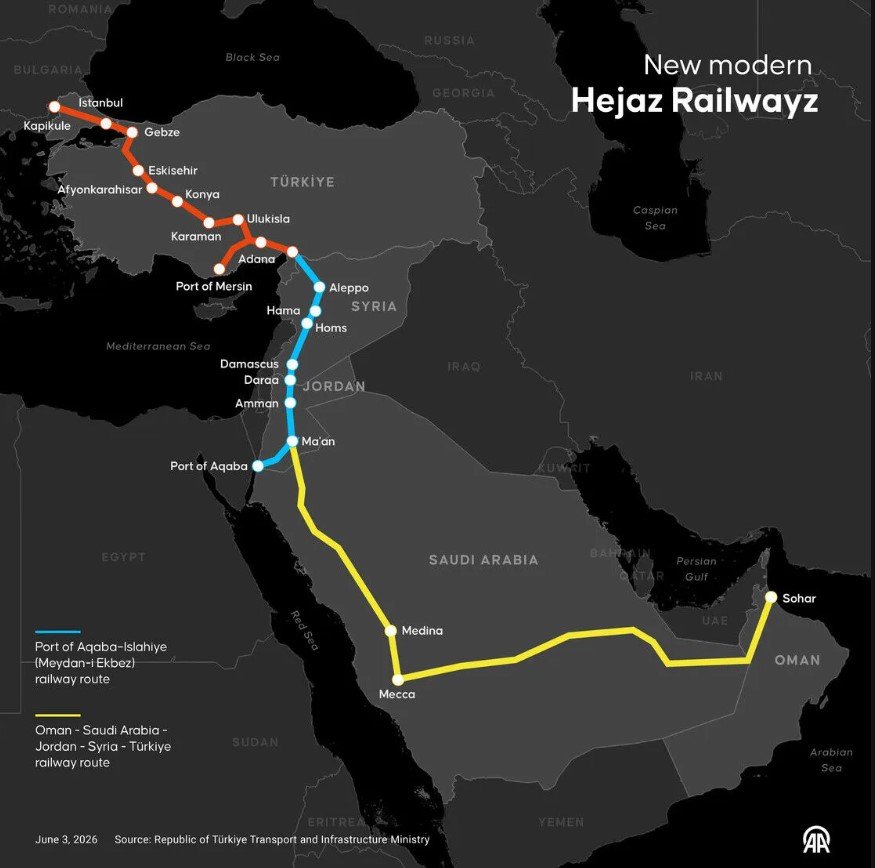
New Modern Hejaz Railway. Source: Anadolu Agency
Dimensional Analysis
Political
Since taking power, Syrian President Ahmed al-Sharaa's government has prioritized rebuilding diplomatic relations beyond Syria's traditional partners, Russia and Iran, by strengthening engagement with neighbouring Arab states, Türkiye, the United States, and international organisations. Backed by Türkiye and several Gulf states, including Qatar and Saudi Arabia, the new government has sought to reposition Syria within the regional political landscape and attract international support for reconstruction. During a visit to Damascus in July, U.N. Secretary-General António Guterres pledged support for Syria's reconstruction, while the United States lifted most sanctions and announced its intention to remove Syria from the U.S. list of State Sponsors of Terrorism. As part of a broader diplomatic agenda focused on strengthening cooperation with neighbouring countries, al-Sharaa has identified stronger relations with Iraq as a cornerstone of Syria's regional diplomacy, emphasising dialogue, institutional stability, and regional partnerships as key priorities of the country's foreign policy. Together, these developments have helped rebrand Syria as a more credible regional partner, creating its most favourable political and investment environment in decades.
Economic
Since the end of the Syrian civil war and with the easing of international sanctions, Syria's economic environment has gradually improved as regional governments and private investors have increased engagement with the country's reconstruction and broader economic recovery. Before the conflict, major trade and transport routes crossing Syrian territory connected ports, manufacturing centres, and regional supply chains across the Middle East. Regional connectivity is now gradually being restored. For example, Turkish Airlines resumed flights to Damascus after a 13-year suspension, reflecting the gradual restoration of commercial air connectivity with Syria.
Economic engagement has also accelerated through growing foreign investment and financial reforms. Saudi Arabia announced US$2 billion in investments across aviation, telecommunications, water, and infrastructure, while the United Arab Emirates unveiled major investment initiatives in infrastructure, telecommunications, aviation, logistics, and real estate. In July 2026, an International Monetary Fund (IMF) mission noted improving economic conditions, highlighting banking reforms, preparations for the 2027 budget, and plans to issue sovereign sukuk, a form of Islamic bonds, to diversify domestic financing. The mission also cited agriculture, tourism, and recovering oil and gas production as key drivers of growth.
Despite this progress, significant structural challenges remain. Years of conflict severely damaged transportation, energy, telecommunications, and financial infrastructure, while banking connectivity is only beginning to recover. Although the security environment has improved, localised instability and the risk of attacks on critical infrastructure continue to pose challenges to reconstruction and investor confidence. Addressing these challenges will require ongoing public and private investment, continued financial reforms, and a stable security environment to support long-term economic growth and attract foreign investment.
Security
Syria's security environment has largely improved over the past several months, with the country recording its lowest levels of Islamic State (ISIS) activity. Government security forces have intensified counterterrorism operations, dismantling ISIS cells and seizing weapons and explosives, significantly degrading the group's operational capabilities.
After years of autonomous administration by the Kurdish-led Syrian Democratic Forces (SDF) in much of northeastern Syria, Damascus has begun to reestablish state authority in the region. On July 30, Hassakeh Governor Noureddine Ahmed announced the integration process between the central government and authorities in Hasakah Governorate was around 70 percent completed, with cooperation expanding into the transportation, telecommunications, banking, and higher education sectors. Ongoing efforts to integrate the SDF, including the incorporation of the Asayish internal security forces and the removal of internal checkpoints, will be essential to re-establishing state control over Hasakah, Syria's principal energy-producing region, which hosts the country's largest oil and gas fields.
Security risks persist despite these improvements. This was demonstrated by the July 2026 bombing near the Palace of Justice in Damascus, which killed at least nine people, and the detonation of two explosive devices near the Four Seasons Hotel during French President Emmanuel Macron's visit, injuring at least 18 others. Beyond these incidents, localised violence, intercommunal tensions, unresolved grievances, and the widespread availability of small arms continue to pose security challenges across the country. Continued Israeli military operations and incursions into southern Syria also present ongoing risks to regional stability and critical infrastructure, while interceptions of Iranian missiles and drones over Syrian territory have increased the risk of falling debris in populated areas.
Key Stakeholders
Syria- Following years of conflict and international isolation, Syria's renewed engagement with regional partners through initiatives such as the Kirkuk–Baniyas Pipeline and the revival of the Hejaz Railway present an opportunity to accelerate economic recovery through foreign investment, transit revenues, and job creation. These projects would also restore Syria's role as a strategic transit hub connecting the Gulf, Iraq, Türkiye, and the eastern Mediterranean, supporting the development of an integrated regional network for trade, transportation, and energy.
Iraq- Iraq relies on the Strait of Hormuz for approximately 95 percent of its oil exports, with oil revenues accounting for around 90 percent of the state budget. During the recent and ongoing U.S.-Israeli conflict with Iran, disruptions to Gulf shipping caused Iraq's seaborne oil exports to fall to just 8 percent of the previous year's average, highlighting the urgency for a western export corridor to the Mediterranean. A revived Kirkuk–Baniyas pipeline would diversify Iraq's export routes, strengthen energy security, support long-term production goals, deepen economic cooperation with Syria, reinforce regional stability, and expand opportunities for U.S. investment in Iraq's energy and transportation sectors.
The United States- The United States supports the rehabilitation of the Kirkuk–Baniyas pipeline as part of its broader strategy to strengthen regional stability and diversify energy export routes. Washington views the project as an opportunity to reduce reliance on the Strait of Hormuz and limit Iran's strategic influence over global energy supplies; according to U.S. Ambassador to Türkiye and Special Presidential Envoy for Syria, Tom Barrack, the pipeline “will make the Strait of Hormuz an afterthought”. At the same time, interest from U.S. energy companies, including Chevron, reflects the project's commercial potential and growing American private-sector engagement in Syria's and Iraq's energy sectors.
Türkiye- Türkiye has prioritised restoring transportation corridors through Syria as part of its broader goal of strengthening its position as a transit hub between the Gulf and Europe. Alongside the revival of the Hejaz Railway, Ankara and Damascus are working to reopen border crossings, restore railway connections, modernise customs procedures, and deepen banking cooperation to strengthen cross-border trade and regional economic integration, with a long-term goal of increasing bilateral trade to US$10 billion.
The Gulf States- Gulf states have increasingly placed economic integration, infrastructure investment, and regional connectivity at the center of their foreign policy. The Gulf views the restoration of Syria's transportation and energy infrastructure as an opportunity to establish integrated trade, logistics, and energy corridors linking the Gulf with the Mediterranean and Europe while reducing dependence on the Strait of Hormuz. With significant sovereign investment capital, Gulf states are expected to play a central role in financing Syria's reconstruction and broader cross-border infrastructure projects as a strategic hedge against future disruptions to Gulf shipping and energy exports.
Opportunities and Risks
Opportunities
Alternative Energy Export Corridor: The rehabilitation of the Kirkuk–Baniyas pipeline would provide a direct export route to the Mediterranean, reducing dependence on the Strait of Hormuz and Gulf shipping lanes. The project aligns with broader U.S. and regional efforts to diversify energy export routes and reduce Iran's strategic leverage over global energy markets by expanding alternative corridors to the Mediterranean.
Regional Economic Integration: The proposed revival of the Hejaz Railway would establish a continuous overland trade corridor linking Türkiye, Syria, Jordan, and Saudi Arabia, reducing transportation costs, strengthening supply chain resilience, and facilitating greater economic integration between the Gulf, the Levant, and Europe.
Reconstruction and Foreign Investment: Improving security conditions and strengthening regional and international partnerships present an opportunity to attract foreign investment for Syria's reconstruction. Rehabilitating transportation and energy infrastructure would stimulate economic growth, create employment, strengthen regional connectivity, and contribute to long-term regional stability.
Risks
Persistent Security Threats: Insurgent attacks, localised instability, and the potential for sabotage continue to threaten transportation corridors and critical energy infrastructure. Any deterioration in security could delay reconstruction, increase project costs, and discourage foreign investment. Attacks by insurgent groups against major infrastructure projects could also be perceived as political victories, undermining confidence in the government's ability to maintain stability.
Political and Geopolitical Uncertainty: The success of regional infrastructure projects depends on sustained political cooperation between Syria, Iraq, Türkiye, Gulf States, and the United States. Changes in regional relations, renewed sanctions, shifts in international policy, or failures to harmonise regulations, customs procedures, and cross-border security protocols could delay implementation, reduce financing opportunities, and weaken investor confidence.
Financing and Implementation Challenges: Rehabilitating Syria's transportation and energy infrastructure will require substantial long-term investment and extensive reconstruction. With Syria’s post-war reconstruction costs exceeding US$200 billion, Syria is likely to prioritize essential infrastructure and public services before major cross-border projects, potentially delaying implementation and discouraging private investment.
Policy Recommendations
Establish a Regional Coordination Mechanism – Syria, Türkiye, Iraq, Jordan, and the Gulf states should establish a permanent regional coordination mechanism to strengthen political cooperation, improve coordination on cross-border infrastructure projects, harmonize customs and technical standards, and strengthen border management.
Enhance Security Cooperation for Critical Infrastructure – Syria, the United States, and its regional partners should strengthen cooperation to protect transportation and energy infrastructure through intelligence sharing, coordinated border security, and counterterrorism operations. Continued security improvements will help protect reconstruction projects and encourage long-term investment.
Expand Public-Private Partnerships and Investment – Regional governments should encourage public-private partnerships and attract greater foreign investment from sources such as the IMF, Gulf sovereign wealth funds, and international private-sector companies. Given the long-term nature and high cost of regional infrastructure projects, diversified financing will be essential to mobilize sustained investment, accelerate reconstruction, and reduce pressure on public finances.
Conclusion
The emergence of regional infrastructure and energy initiatives such as the Kirkuk–Baniyas Pipeline and the Hejaz Railway presents Syria with a unique pathway to accelerate reconstruction, strengthen regional cooperation, and support the country's reintegration into the regional and international community. Improving security conditions, renewed diplomatic engagement, expanding regional partnerships, and growing international investment have created the most favourable environment in decades to advance these initiatives. However, realizing this potential will depend on overcoming significant political, security, financial, and governance challenges through sustained regional cooperation, long-term investment, and effective implementation. If successful, these projects have the potential to restore Syria's role as a critical transportation and energy corridor, strengthen regional trade and energy security, reduce reliance on the Strait of Hormuz, and contribute to greater economic integration and stability across the Middle East.
Written by Oscar Bermudez
Analyst on the MENA Research Desk