
A Security Pact Built on More Than Defence
September 03, 2026 - Written by Turhan Hizli
Introduction
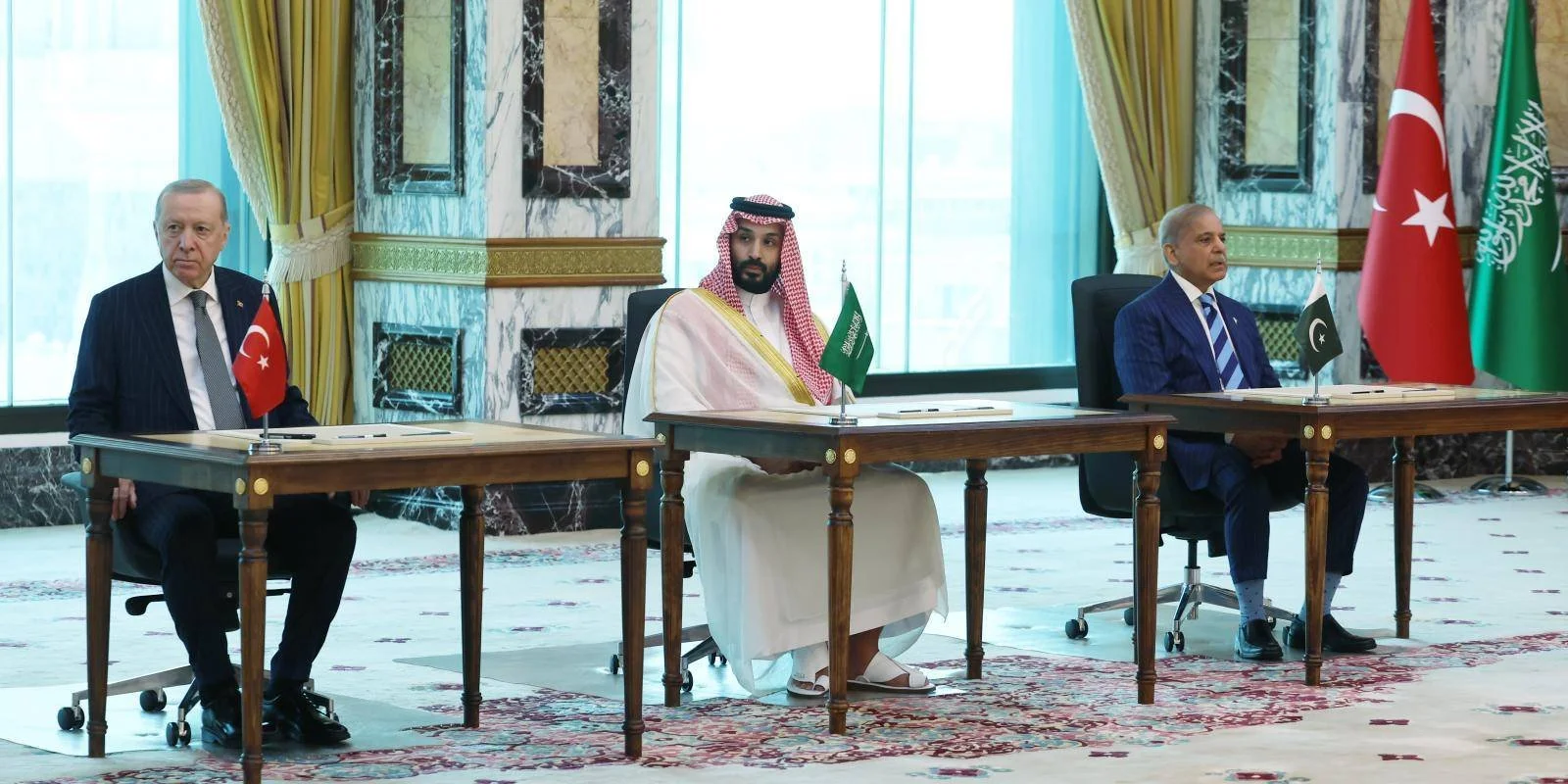
On 7 August 2026, Türkiye, Pakistan and Saudi Arabia signed the Mecca Joint Defence Agreement to “strengthen collective deterrence against any act of aggression”. In its official text, it covers joint military exercises, intelligence sharing, training and technology transfers. The agreement is explicitly defensive, does not replace existing security arrangements and is not directed against any particular actor or threat. It brings together oil-rich G20 member Saudi Arabia, the Muslim world's only nuclear-armed state, Pakistan, and Türkiye, which has NATO's second-largest military. The latter two are also major defence manufacturers and exporters. These complementary capabilities are underpinned by shared religion, cultural heritage and broadly convergent strategic interests, particularly on Syria’s new regime, the respect for territorial integrity and Israel’s occupation of Palestinian territories.
The excitement surrounding the so-called “Islamic NATO” is unlikely to translate into a fundamental restructuring of its members’ security apparatuses. The grouping is significant regionally and, on paper, carries echoes of NATO’s Article 5. But, at least in the short term, it lacks the institutional depth, established command structures and political credibility that make NATO’s collective defence commitment meaningful. Nor is there any indication that Saudi Arabia, Türkiye or Pakistan intend to abandon Washington, NATO or their existing security partnerships. The logic is instead one of hedging: building additional security options in case existing relationships prove less reliable. This makes the emerging arrangement less a replacement for existing alliances than a complementary layer of security cooperation.
Furthermore, its importance lies as much in the economic and commercial weight of its members as in their military potential. Saudi Arabia brings financial capital and energy resources; Türkiye an increasingly capable defence industry; and Pakistan a large, experienced military and access to strategic trade routes. The framework creates incentives that extend beyond collective security, including defence procurement and industrial cooperation, as well as investment and economic partnerships. Defence cooperation can also strengthen the conditions for economic engagement. By strengthening collective security, the pact could reduce perceived sovereign risk and encourage greater trade, investment and economic integration. The pact therefore also offers a mechanism through which three states can simultaneously expand their security options and pursue economic and strategic interests.
Why Now
The traditional regional security model depended heavily on external guarantees. Recent events, particularly the Iran War, faltering US security guarantees, and Israel’s increasingly assertive role in the region and occupation of southern Lebanon and Palestinian territories, have exposed the risks of that dependence.
The pact also reflects a shared exposure to the economic and security consequences of the wider regional conflict. Disruptions to shipping through the Strait of Hormuz have threatened energy supplies, with import-dependent Türkiye and Pakistan particularly vulnerable to further disruption. So, all three, have an interest in containing the conflict before it imposes wider economic and security costs. For Saudi Arabia and Türkiye, the threat is already more direct, given attacks linked to the regional conflict, while both Ankara and Islamabad remain concerned about instability spilling across their long borders with Iran. The wider conflict has also strengthened the position of Iran and the Houthis, increasing the pressure on Saudi Arabia and adding another incentive for Riyadh to strengthen its regional security partnerships.
Three Countries, Three Calculations
Saudi Perspective
Saudi Arabia's long-standing image as a relatively secure investment hub has been challenged by the spread of regional conflict, particularly, by its exposure to Iranian and Houthi-led strikes, which has tarnished its image as a safe investment hub. Although the US remains Saudi Arabia's primary security provider, these attacks have also highlighted the limits of relying on a single external guarantor. Riyadh's response has increasingly been one of hedging: maintaining its relationship with Washington while developing additional security partnerships that could provide greater manoeuvrability.
The agreement therefore offers Saudi Arabia more than another military relationship. Pakistan provides a large and experienced military. Before assuming its mediation role in the Iran War, Pakistan provided 8,000 troops, drones and air-defence systems to minimise Saudi’s vulnerability. Similarly, closer cooperation with Ankara could provide Riyadh access to additional training and sophisticated defence technologies at favourable terms and without strict conditionalities such as human rights, democratisation, and minority rights. Along with an opportunity to indigenoise Saudi Arabia’s defence industry. Saudi Arabia’s relationship with the US has also been complicated by disagreements over arms sales and Washington’s insistence on greater rapprochement with Israel.
Saudi Arabia seeks to tap into the defence-industrial capabilities of both countries while leveraging its sovereign wealth and energy resources. The objective is therefore to build greater redundancy in its security partnerships by developing alternative sources of defence equipment, technology and military support while reducing its dependence on the US security umbrella.
Turkish Perspective
For Türkiye, the pact combines commercial opportunity with regional hedging. Ankara already possesses NATO's security guarantees and one of the region's most capable armed forces, meaning that it has less need for an additional security guarantee than Saudi Arabia or Pakistan. Its interest lies partly in what the arrangement can offer alongside its existing alliances.
The most immediate opportunity is commercial. Türkiye has developed a rapidly expanding defence industry and is seeking overseas markets for its drones, naval systems, armoured vehicles and other military equipment. A closer security relationship with Saudi Arabia and Pakistan could generate demand for Turkish defence products while opening opportunities for “joint production, technology partnerships, procurement and greater military interoperability”.
But the strategic value extends beyond arms exports. Türkiye has pursued a multi-vector foreign policy, maintaining its position within NATO while simultaneously expanding relations with the Gulf, Russia, Central Asia and other non-Western partners. The new framework fits this broader approach: rather than abandoning existing alliances, Ankara can cultivate alternative relationships that increase its strategic options and potentially strengthen its bargaining position within them. The pact offers Türkiye both a market for its defence industry and another instrument through which to project regional influence.
Pakistani Persective
Pakistan's calculation is perhaps the most economically consequential. Islamabad has long relied on close relationships with Saudi Arabia for financial support, investment and energy supplies given that Saudi Arabia provides much of its hydrocarbons and is home to 5.5 million of Pakistani expatriates. For a country facing persistent economic constraints, the ability to turn strategic relevance into investment, energy access and defence-industrial cooperation is itself a form of geopolitical leverage. Saudi loans could be converted into military equipment packages, helping Pakistan preserve its much-needed foreign exchange reserves. Whether or not these arrangements are directly linked to the joint defence agreement, Pakistan’s active participation as a reliable actor could boost investor confidence and secure lucrative oil deals. It is currently striving to secure a $6.7 billion concessional oil financing facility at an interest rate of just 1% from Saudi Arabia. This would ease Pakistan’s energy security concerns amid highly volatile oil prices.
While its military remains one of the country's most important sources of international influence, the new framework could therefore institutionalise an exchange that has historically operated through bilateral relationships: Pakistani military capabilities in return for Gulf financial and economic support.
Cautious Optimism and Complications
The limits of the arrangement become clearer when tested against actual regional contingencies. The alliance is far less institutionalised than NATO, and the principle of “an attack on one is an attack on all” does not carry the same weight as NATO’s Article 5. Would Türkiye really intervene if Saudi Arabia were drawn into a major conflict with the Houthis or Iran? And how would Ankara respond if Iran-backed groups began targeting Turkish commercial interests or trade routes in the Horn of Africa? Tehran could also seek to exploit its networks within Pakistan, home to a large Shia minority, to disrupt its internal sectarian cohesion, creating another scenario in which the alliance’s mutual defence commitment would be tested.
The same uncertainty applies to Pakistan’s rivalry with India. If sporadic clashes were to escalate into a major war, would Türkiye and Saudi Arabia actually intervene on Pakistan’s behalf? India has already taken note of the emerging alignment and could respond by deepening cooperation with Türkiye’s regional rivals, including Greece, Israel and the UAE. For Ankara and Riyadh, the costs of turning a security partnership with Pakistan into a direct confrontation with India would be considerable.
Nor should Pakistan’s nuclear capability be treated as an extension of the alliance’s collective security guarantee. Pakistan’s nuclear arsenal is primarily geared towards its immediate security environment and does little to provide a meaningful nuclear umbrella for partners in the Middle East. Similarly, the “technology transfer to Saudi Arabia or Türkiye may breach the NPT and risk international isolation, particularly in Türkiye’s case, given that it is already protected by NATO’s nuclear umbrella. More importantly, Islamabad is unlikely to jeopardise its emerging image as a mediator by adopting an overtly confrontational posture towards Türkiye’s or Saudi Arabia’s regional rivals.
The agreement’s immediate value is more likely to lie in deterrence than in military intervention. Closer defence cooperation could create useful complementarity between the three countries: bringing capital into Pakistan and Türkiye’s defence sectors while strengthening Saudi Arabia’s military capabilities. But this is unlikely, at least in the near term, to produce NATO-style integration across intelligence sharing, defence planning, command structures and defence production.
Its significance lies elsewhere. By signalling that an attack on one member could carry consequences beyond the bilateral relationship, the agreement introduces an additional layer of uncertainty for potential adversaries. It may not guarantee that the others will come to a member’s defence, but it raises the potential cost of doing so. In that sense, the agreement may prove more valuable as a mechanism of strategic ambiguity and deterrence than as a blueprint for collective warfighting.
A New Security Architecture?
One agreement does not create a new regional security architecture. But if followed by joint exercises, defence-industrial cooperation, intelligence sharing and further agreements with other regional states, it could become one of its building blocks. The emerging model is not a replacement for NATO or the US security system. It is a world of overlapping security partnerships in which middle and regional powers seek to avoid relying entirely on any single external guarantor.
The ambiguity is also deliberate. By leaving commitments loosely defined, member states retain room to manoeuvre and can deepen cooperation without being locked into automatic obligations. That flexibility, however, cuts both ways. The more these states hedge against their traditional partners, the greater their strategic autonomy becomes. But as security commitments begin to overlap, so too does the risk of entanglement. What is designed as a means of keeping options open could ultimately create new obligations and draw states into conflicts they had no intention of fighting.

Written by Turhan Hizli
Contributor to the MENA and Türkiye Research Desks