
Ukrainian Drone Co-Production in Europe
July 28, 2026 - Written by Simone Chiusa
Europe hosts and funds Ukrainian drone production and buys almost nothing from it. The distance between those two facts defines what European states have actually acquired, and the policy conversation about co-production tends to step over it. The framework is Build with Ukraine, launched in mid-2025. Ukraine supplies skilled personnel and specialised knowledge, while European partners supply capital, technology, production infrastructure and the certification capabilities that open EU and international markets.
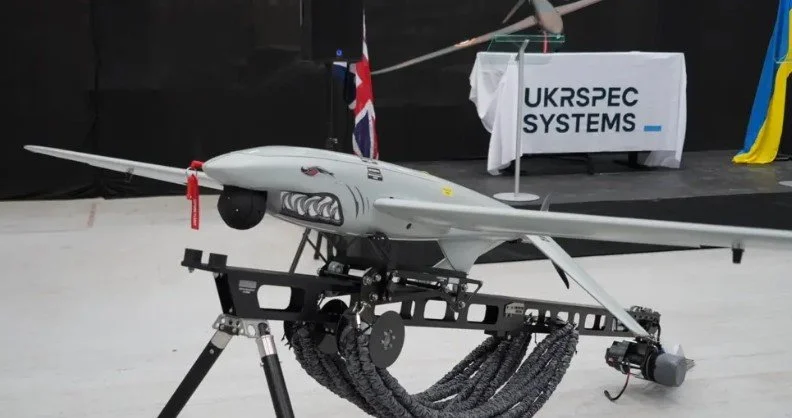
The model is already running on German and British soil. Quantum Frontline Industries, a joint venture between Germany’s Quantum Systems and Ukraine’s Frontline Robotics, began serial production of the Linza in Germany in February 2026, with planned output of 10,000 units a year. Auterion Airlogix Joint Venture produces AI-guided medium-range strike drones, also in Germany. Ukrspecsystems opened a £200 million production and testing facility in England in February for its PD-2 and Shark platforms. Since January, Britain has produced the Octopus interceptor, a Ukrainian design refined by British engineers, at planned volumes of up to 1,000 units a month.
Both systems are combat-proven, which is a quality European primes cannot manufacture, and Ukrainian firms hold by default. What is being produced on European soil is therefore a specific, combat-hardened system, with a design already tested on the battlefield. The joint ventures allow European partners to skip years of iteration and adjustment, inheriting a product that already meets combat needs.
However, almost none of what gets built enters a European inventory. On 30 June, the European Commission began disbursing €3.9 billion, the first payment of a roughly €6 billion tranche under the €90 billion Ukraine Support Loan, and the money is earmarked for drones manufactured in Ukraine. Of the loan’s €60 billion defence component, €28.3 billion is scheduled for release in 2026 to build Ukraine’s defence industrial capacity. Europe is landlord, financier and creditor to the purchasing state, not the purchaser.
The joint ventures are not a supply arrangement, and the volumes make that clear. Quantum Frontline Industries plans 10,000 units a year in Germany. The Octopus line in Britain is scheduled for up to 12,000 a year. Taken together, Europe’s flagship co-production sites are working towards something in the region of 22,000 drones annually. Ukrainian producers built roughly five million drones in 2025, and Ukrainian units drew 485,000 systems through DOT-Chain in the first half of 2026 alone. The Ukrainian partners listed on the Intelic platform are said to produce more than 100,000 unmanned aircraft a month between them. European co-production, on the most generous reading, accounts for a fraction of one per cent of what Ukraine puts into the field. The composition of the output points the same way. What Europe builds is the expensive end. The cheap attritable tier stays in Ukraine, which is where the FPVs and the thousand-dollar interceptors that constitute the actual Ukrainian revolution are made. Europe is importing the part of Ukrainian industry that most closely resembles Europe.
That leaves a different explanation for what these plants do. They secure European capital, European certification, and access to the EU market. They place production beyond the range of the Russian strikes that regularly hit plants inside Ukraine. Notably, survey data found 51% of Ukrainian drone manufacturers considering relocation abroad, with 89% citing security reasons.
What Actually Transfers
The Ukrainian advantage sits in the iteration cycle, and this determines what can be transferred at all. Kyiv’s advantage lies in its capacity to adapt systems quickly to changing operational conditions and to test them in combat, with Ukrainian firms updating designs in weeks, and operators' feedback feeding straight into new production runs. A European factory can replicate an airframe, but replicating that loop requires the demand side that drives it, and the demand side is not part of the deal. Also, Ukraine has established a price standard, managing to produce cheap drones and interceptors at a fraction of the price of their Western counterparts.
But reproducing that price is unsuitable for Europe. Ukraine has cut the Chinese share of its drone components to roughly 38% and can now build drones with no Chinese parts at all, but mass production at that standard remains years away because Chinese components are cheaper. Ukrainian components already run tens of per cent above the Chinese equivalent. A European industry reshoring its supply chain will not hold Ukrainian prices. Nor does wartime tolerance for failure travel, and Europe should not want it to. Battlefield feedback compresses testing timelines in ways NATO acquisition agencies may not accept, and wartime systems carry unresolved questions of certification, quality control and component security.
The Procurement Gap
Ukraine’s procurement system is the component European co-production leaves behind. Kyiv’s defence procurement agency runs DOT-Chain Defence, a digital marketplace on which frontline units select equipment directly. Average time from order to delivery of an in-stock item isnine days. In the first half of 2026, units received 485,000 drones and associated equipment worth roughly $697 million.
A March 2026 reform changed how requirements are written: units submit operational needs to the General Staff, which defines the capability required, such as range, payload and strike profile, and leaves the model and the manufacturer open. Procurement decisions are then informed by combat performance data drawn from DOT-Chain, Brave1 Market, eBalov and the DELTA battlefield management system.
That mechanism cannot be imported in European capitals, and the firm that tried says so. Intelic BASE, launched by the Dutch company Intelic, is a procurement hub connecting European defence ministries to unmanned systems from ten countries and Ukraine, explicitly modelled on Brave1. Asked how it differs from the Ukrainian original, chief executive Maurits Korthals Altes said Ukrainian units can buy directly from their marketplace, and that EU procurement “is not set up for” that.
What Europe has Bought
Ukraine is converting battlefield knowledge into industrial position inside the European single market, and it is doing so deliberately. Kyiv sets political conditions on who may partner with its firms. Zelensky has announced ten overseas defence export hubs by the end of 2026, including London, Berlin and Copenhagen. When the fighting stops, Ukrainian companies will hold EU certification, EU production facilities, EU market access, a lower cost base and an iteration cycle European primes cannot match. That is a competitive position inside the single market, financed by the market it will compete in.
The part Europe has not bought is the part that is actually for sale. Requirements written by end users with budgets, contracts rotated on measured performance, and a combat-data rating layer of Europe's own are all portable, and none of them requires a factory. Europe has taken the physical risk of hosting and the political risk of Russian coercion, and declined the institutional change that would make the arrangement pay. The factories will produce either way. Whether they produce anything a European army can use depends on procurement decisions that have nothing to do with drones.
Possible Targets?
Hosting Ukrainian production has made Europe a potential target of Russia’s attacks. The Russian defence ministry released a list of eleven Ukrainian company branches across the United Kingdom, Denmark, Latvia, Germany, the Netherlands, Lithuania, Poland and the Czech Republic, plus ten component suppliers, with addresses attached. Dmitry Medvedev called it “a list of potential targets for the Russian armed forces”. The publication came the day after Volodymyr Zelensky and Friedrich Merz met in Berlin and were shown drone models built at joint Ukrainian-German enterprises. This new threat adds to the already long lists delivered by Russia in the last few years.
Read as a missile targeting product, the list is not serious. Possibilities of actual strikes against those plants are close to zero. The significance is more subtle, and it could be part of the wider hybrid warfare campaign Russia is running against Europe. Moscow’s intelligence has spent years outsourcing sabotage in Europe to recruits hired through Telegram, a model built on petty criminals, migrants and the financially desperate rather than trained officers. The pattern already includes the specific offence at issue here. In March 2024, a warehouse in London storing goods bound for Ukraine was set on fire by a group recruited online and directed by Wagner-linked handlers. And there had been many more cases of sabotage and arson attacks. Therefore, the published address list works as an input to that process.
Since 2022, Russia has been conducting an intensive hybrid warfare campaign against Europe. Moscow-linked attacks on the continent quadrupled between 2022 and 2023, and nearly tripled the following year. Industry and critical infrastructure are the primary target categories. This does not mean the threat is imminent, and the Kremlin has an interest in Europeans overestimating it. Nevertheless, European states are forced to take precautions and keep their eyes open.
The Path Ahead
As cooperation in R&D deepens, and European partners begin entering joint ventures as customers, importing co-developed systems into their own arsenals, the arrangement starts closing Europe’s capability gap with platforms already proven in combat.
In June, Ukraine, Denmark, France, Germany, Italy, the Netherlands, Norway, Spain, Sweden, and the UK launched the Integrated Anti-Ballistic Missile Coalition, built around Kyiv’s low-cost FREYJA missile defence program. The goal is to strengthen Europe’s air defences. Ukraine contributes by supplying its FP-7 interceptor with its launch and control elements, while several European firms will provide the sensors, seekers and command and control.
The EU-Ukraine Drone Deal recently signed points in the same way, setting joint drone and counter-drone production for the end of 2026 and joint anti-ballistic missile production for 2028. Joint development of this kind transfers actual engineering practice, and Europe has the unique possibility of learning and implementing the state-of-the-art Ukrainian systems.

European Research Desk Analyst