
Venezuela’s Multidimensional Grey-Zone Campaign in the Essequibo Region
December 10, 2025 - Written by Eduardo B. Xavier
Summary
Venezuela has put into place a multidimensional grey-zone campaign in the Essequibo Region-based on grey-zone strategies and a five-step “hybrid kit”, meaning a coordinated package of legal, informational, military, economic, and external-support levers designed to pressure Guyana below the threshold of open war - to force asymmetric negotiations. The U.S. introduction of a Joint Task Force (JTF) in Q4 2025 has reshaped the regional security architecture, creating a crowded maritime battlespace where Venezuelan patrol boats, offshore platforms, commercial shipping, and U.S. naval units operate in close proximity - and with it, a critical risk that a minor incident or misread manoeuvre at sea could spiral into unintended escalation.
Why it matters
The Precedent of Coercion and the Regional Order
The dispute over the Essequibo Region has moved beyond a border quarrel to become a key stress test for South America’s rules-based order. At its core is Caracas’ “hybrid kit” - a mix of domestic decrees and calibrated military signalling - which has become a global test case: if it extracts concessions outside the International Court of Justice (ICJ), it opens a precedent for other frozen conflicts.
Existential Risk and Guyana’s Energy Rise
The dispute sits on the border of the world’s most prolific new energy frontier, in Guyana. Guyana, with 800,000 inhabitants, holds recoverable reserves above 11 billion barrels in the Stabroek Block. The International Monetary Fund (IMF) projects the country will keep the world’s fastest real gross domestic product (GDP) growth in 2025/26. Instability in Guyana’s exclusive economic zone (EEZ) threatens sovereignty and development by raising maritime insurance premiums and the perceived physical-security risk for ExxonMobil, Hess, and China National Offshore Oil Corporation (CNOOC).
The Situation — Contextual Analysis
1. Juridification: The Clash Between 1899 and 1966
The impasse between Venezuela and Guyana rests on two irreconcilable readings of international legality.
The Guyanese Position (Res Judicata): The leadership of Guyana in Georgetown upholds the enduring validity of the 1899 Paris Arbitral Award that fixed the country’s present borders. The ICJ provisional measures order (Dec 2023), banning any changes to the 1899 Paris Arbitral Award, operated as a diplomatic shield reinforcing a long- precedented legal track in The Hague. Days later, the Argyle Declaration was publicly formalised at the Argyle meeting in St. Vincent between Guyanese President Irfaan Ali and Venezuelan President Nicolás Maduro, committing both states to non-use of force and preserving the political channel.
The Venezuelan Position (Absolute Nullity): Caracas claims the 1899 Paris Arbitral Award is void, citing the Mallet-Prevost Memorandum - a posthumous account by Venezuela’s counsel alleging that the tribunal’s president brokered a political deal that pressured the arbitrators into a unanimous award favourable to Britain - and anchors its strategy in the 1966 Geneva Agreement, which recognises a “controversy” over the 1899 Award and creates a political negotiation track (mixed commission and, failing that, UN-mediated procedures) to reach a “practical settlement.” Venezuela reads this not as a mandate for ICJ adjudication, but as licence for open-ended political bargaining.
2. Politicisation and Internal Mobilisation (Survival Strategy) For Nicolás Maduro’s regime, the Essequibo Region became an existential tool of internal cohesion. The strategic turn came with the consultative referendum of 3 December 2023, where the government claimed 95%+ approval across five questions, including rejecting the ICJ and creating the “Guayana Esequiba” state - a new Venezuelan federal state on paper that would formally incorporate the disputed territory currently administered by Guyana, despite Venezuela not exercising effective control there.
This mandate was institutionalised by the Organic Law for the Defence of Guayana Esequiba (April 2024), which built a parallel administrative architecture for a territory that Venezuela does not physically occupy, prompting a Caribbean Community (CARICOM) reaction in the form of a strong joint statement warning that the law risked escalating tensions, undermining the ICJ process, and violating Guyana’s sovereignty.
3. Economic Securitisation: The Oil Timeline
Offshore success accelerated militarisation. Guyana’s installed capacity hit a critical inflection in Nov 2025, with production surpassing 900,000 barrels per day (bpd). The jump stems from the Yellowtail drilling site (250k bpd) coming online in 2025 alongside Liza I/II and the Payara drilling sites; with the Uaru sites (2026) and Whiptail site (2027) already approved, Guyana is on track to top 1.3 million bpd within 24 months. For a beleaguered Venezuela still struggling to recover its oil sector, this neighbouring boom is read as a zero-sum geoeconomic threat.
Core Arguments & Strategic Logic
Venezuela’s “Hybrid Kit” (Five Pieces)
Caracas operates a five-lever grey-zone system designed to exhaust Guyana without triggering mutual-defence thresholds:
1. Information and Narrative: Caracas frames Essequibo as “historical reparation” against British and corporate imperialism, using state networks, digital proxies, and cyber-enabled messaging to amplify information operations and erode Guyana’s diplomatic solidarity.
2. Lawfare and Procedural Dual Clocks: Venezuela plays on two legal timelines: internationally, it drags the ICJ process; domestically, it uses the Organic Law to manufacture instant sovereignty. The core mechanism is the tactic of using instrumentalised law to impose temporal and political asymmetry.
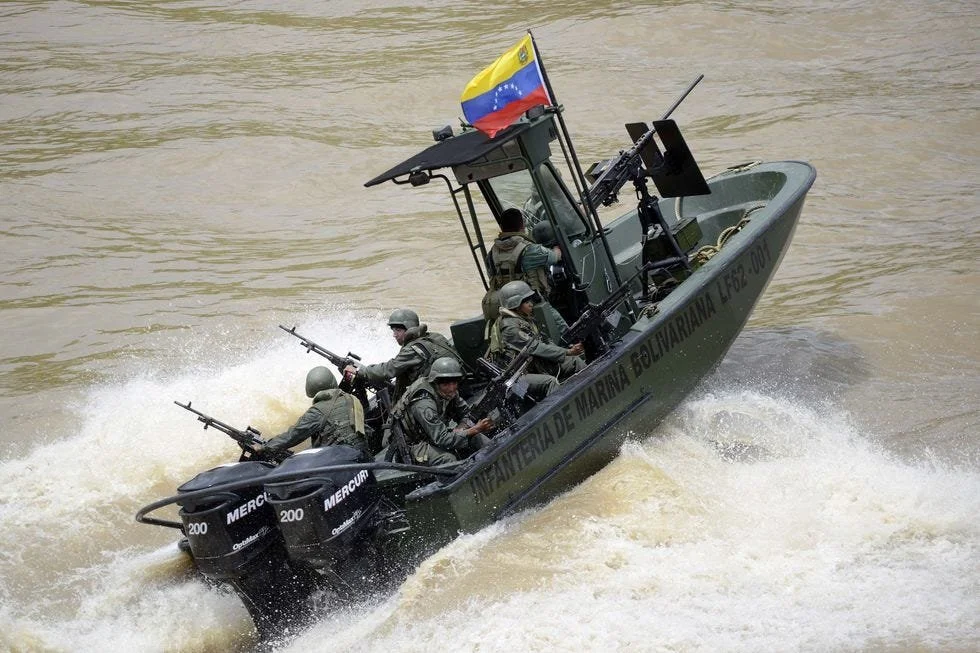
3. Calibrated Security Signals: Naval and air incursions are episodic but standardised. As noted by the Center for Strategic and International Studies (CSIS), they seek visibility and investor risk rather than combat; in 2025 this pattern materialised in naval incursions recorded by Guyana Defence Force (GDF).
4. Economic Lever (Cost Imposition): The primary goal is to raise the “Guyana Cost.” Security ambiguity aims to lift war-risk premiums and delay offshore logistics, functioning as an indirect economic sanction.
5. External Tech-Industrial Depth (Logistical Depth): Venezuela’s ongoing partnership with Moscow materially sustains the campaign: beyond the Kalashnikov ammunition plant (70 million rounds/year), Russia maintains and renews the military support pipeline to Caracas, including recent layered air-defence reinforcements - such as Buk-M2E and Pantsir-S1 -added to the S-300VM core, raising the ability of Venezuela to ward off external coercion.
The U.S. Variable
The Hybrid Kit plan by Venezuela held through Q3 2025, but the balance shifted with the U.S. operation called Southern Spear. Under counter-narcotics legal cover, United States Southern Command (USSOUTHCOM) - the U.S. geographic combatant command responsible for Latin America and the Caribbean - established a Joint Task Force (JTF) for interdiction, surveillance, and rapid response and then escalated presence with the Carrier Strike Group of the USS Gerald R. Ford, expanding surface ships, intelligence, surveillance and reconnaissance (ISR), and kinetic readiness. This saturation of military might in the region imposes a visible operational ceiling: Venezuelan actions at sea become immediately detectable, trackable, and - if needed - interceptable without formally constituting interstate escalation.
Military Saturation raises the cost of amphibious annexation but increases the risk of incidents in waters congested with Venezuelan patrols, oil platforms, logistics traffic, and U.S. forces, shifting deterrence to the tactical-operational level.
Data points:
• 1 Dec 2023: the ICJ issued provisional measures barring any change to the status quo in Essequibo.
• 14 Dec 2023: the Argyle Declaration formalised a non-use-of-force commitment.
• 3 Dec 2023: Venezuela’s consultative referendum approved (95%+) rejecting the ICJ and creating “Guayana Esequiba.”
• Nov 2025: Guyana passed 900k bpd and projects >1.3 million bpd within 24 months.
• Oct 2025: SOUTHCOM activated the JTF and deployed the Gerald R. Ford Carrier Strike Group (CSG) to the Southern Caribbean.
Key Players and Stakeholders
Venezuela (Maduro Regime/Fuerza Armada Nacional Bolivariana - FANB)
Position: Revisionist/offensive.
Interest: Essequibo acts as a legitimacy pillar for civil-military unity. The FANB, under Padrino López, backs the regime but faces constrained force projection due to sanctions and platform degradation, incentivising controlled tension to force bilateral talks without direct confrontation.
Guyana (Ali Government/GDF)
Position: Defensive/status quo.
Interest: Existential. Losing Essequibo would mean forfeiting 70% of national territory and most oil reserves.
Strategy: “Total internationalisation.” Georgetown built a robust coalition (CARICOM, Commonwealth, Organisation of American States - OAS) and securitised defence through U.S. and UK partnerships, using the Argyle Declaration as proof of good faith.
Stabroek Consortium (ExxonMobil, Hess, CNOOC)
• ExxonMobil (45% – operator): acts as a quasi-sovereign in Stabroek, setting the economic pace; fast-tracking Yellowtail and Uaru consolidates economic facts at sea.
• CNOOC (25%): a quiet but decisive stakeholder; China’s equity makes Beijing a direct beneficiary of Guyanese oil, complicating Caracas’ anti-imperialist narrative and moderating Chinese diplomatic support to Maduro.
• Hess (30%): focused on shareholder value, the most market-risk-sensitive link.
Brazil (Itamaraty/Ministry of Defence)
Position: Active neutrality/reluctant mediator.
Interest: Regional stability and border integrity.
Action: Brazil reinforced its military posture in Roraima (Operation Roraima) to deter Venezuelan incursions via Brazilian territory, manage migration flows, and prevent the area from becoming a proxy-war arena between the U.S. and Russia/China.
United States (SOUTHCOM/State Dept.)
Position: De facto security guarantor.
Interest: Protecting strategic energy routes and containing Russian influence. The reactivation of the Fourth Fleet and creation of the JTF mark the end of “benign neglect” in the Caribbean.
Military, Economic and Social Dimensions
Military Dimension
Venezuela sustains a limited anti-access/area-denial (A2/AD) bubble built around S-300VM and Su-30MK2 to pressure Guyana’s airspace; without combat aviation, Georgetown relies on extended deterrence from partners. The critical vector is saturation: the maritime area off the Orinoco Delta hosts civil floating production, storage and offloading (FPSO) traffic, fixed platforms, Venezuelan patrols, and U.S. assets, sharply increasing the risk of unplanned incidents.
Economic Dimension
Venezuela seeks to lift Lloyd’s war-risk premiums to make Guyanese oil costlier and slower. With expanding onshore/offshore assets (FPSO One Guyana), Guyana becomes more exposed to partial naval blockades and hybrid sabotage along contested supply routes.
Social Dimension
Indigenous populations across Essequibo’s core - especially Arawak/Lokono and Warao, within a broader transboundary indigenous belt - are being drawn into state-level messaging and claims over the territory. As the dispute hardens into administrative moves and security signalling, indigenous land rights become more ambiguous, fuelling fears of militarisation of ancestral areas and displacement pressures on core communities. This combination undermines long-standing livelihood systems rooted in farming, fishing, forest use, and cross-border mobility, as documented among indigenous groups in the region.
A further instability vector is the Venezuelan diaspora already in Guyana, now sizeable in a small-population country. Both sides may instrumentalise it: Caracas as “historical human linkage,” some Guyanese sectors as a potential “fifth column.” In grey-zone logic, this perception struggle can translate migration into community friction, stigma, and diffuse low-intensity violence.
Opportunities and Risks — Outlook 2026
Immediate Risks (High Impact / Medium Probability)
Accidental Naval Trigger: With territorial invasion blocked by Southern Spear, the Venezuelan Navy is likely to resort to tactical harassment (unsafe intercepts, bow-crossing) for domestic signalling. The most immediate risk is miscalculation: a junior commander misreading a manoeuvre could spark real hostilities, as warned by the International Crisis Group.
CARICOM Fracture: Prolonged pressure may erode regional cohesion. Small Caribbean states reliant on cheap energy and Petrocaribe legacies may relativise support for Guyana, weakening consensus in the OAS and UN.
Opportunities and Buffers
Extended deterrence: U.S. presence imposes an operational ceiling on Maduro’s ambitions, keeping the conflict in the grey zone.
Defensive industrial resilience: the ammunition plant signals preparation for prolonged resistance, prioritising regime survival over immediate external conquest.
Policy Recommendations
For the Government of Guyana (Georgetown):
• Radical transparency (defensive lawfare): deploy a public automatic identification system (AIS)/satellite EEZ dashboard to counter disinformation and convert every provocation into time-stamped, chain-of custody evidence. Maintain an archived incident log to support ICJ-consistent legal positioning.
• Diplomatic backchannel: use Brazil as a discreet channel with Caracas to agree on maritime/air incident-prevention protocols (CUES-style): pre-notification for major movements, deconfliction lanes, commander hotlines, and a clear escalation ladder. Goal: mechanical risk-reduction, not political alignment.
• Joint training for interoperability & calibrated deterrence: scale up predictable, publicly framed defensive exercises with trusted partners, kept transparent and scheduled. Focus on EEZ patrol routines, airspace cueing, global navigation satellite system (GNSS)-denial/jamming resilience, rapid incident response, and humanitarian assistance and disaster relief (HA/DR)—raising readiness without feeding escalation narratives.
• Qualified mobilisation & force generation: build a tiered readiness model (active + trained reserve + civil-defence auxiliaries) with pre-certified call-up rosters, short recurrent training cycles, and a single disciplined command-and-control (C2) chain. Prioritise border/EEZ protection, logistics/engineering, medical support, and incident-response teams; avoid ad-hoc militias.
• ISR/maritime domain awareness (MDA) upgrade + forward border posture: invest in a layered ISR architecture (coastal/riverine sensors, AIS analytics, unmanned aerial vehicle (UAV) patrols, commercial satellite tasking) fused in a national cell, with cueing protocols from detection → attribution → calibrated response. In parallel, reinforce light, permanent early-warning nodes along the border belt (observation posts, riverine pickets, rapid-reporting patrol patterns) tied to ISR, with defensive ROE and ICJ-consistent framing.
For investors and Operators:
• Insurance calibration: adapt coverage to grey-zone disruptions (temporary EEZ closures, port slowdowns, jamming-related aviation risk), not just declared war; review force-majeure clauses and premium triggers with underwriters.
• Signal monitoring: track Venezuelan naval and air-patrol movements via open-source intelligence (OSINT) (AIS gaps, satellite cues, official communiqués) as a leading indicator of tension spikes, rerouting risk, and short-cycle market volatility.
Conclusion
Essequibo entered a new phase in 2026 as Caracas’ Hybrid Kit met U.S. naval saturation. U.S. primacy blocks near-term overt annexation, but shifts coercion into deniable decrees, symbolic militarisation, and maritime/air probes that keep Georgetown negotiating under ambiguity. The theatre becomes permanently unstable: peace depends on operational discipline, ISR transparency, and calibrated Guyanese readiness to prevent miscalculation from escalating. For partners, the task is to sustain evidence-based defensive lawfare, joint training, and incident-prevention channels. Deterrence raises the kinetic ceiling, yet leaves a persistent grey-zone floor where tactical errors, not grand strategy, can trigger crises and investor shocks. Essequibo is thus a long-duration grey zone contest testing regional rules, not a settled border dispute.

Written by Eduardo B. Xavier
Analyst on the LATAM & Caribbean Research Desk