
Ceuta and Melilla Migrants Crisis: What lay behind them and what has been the impact on the Spanish government and EU?
October 19, 2026 - Written by Thomas Acratopulo
Background
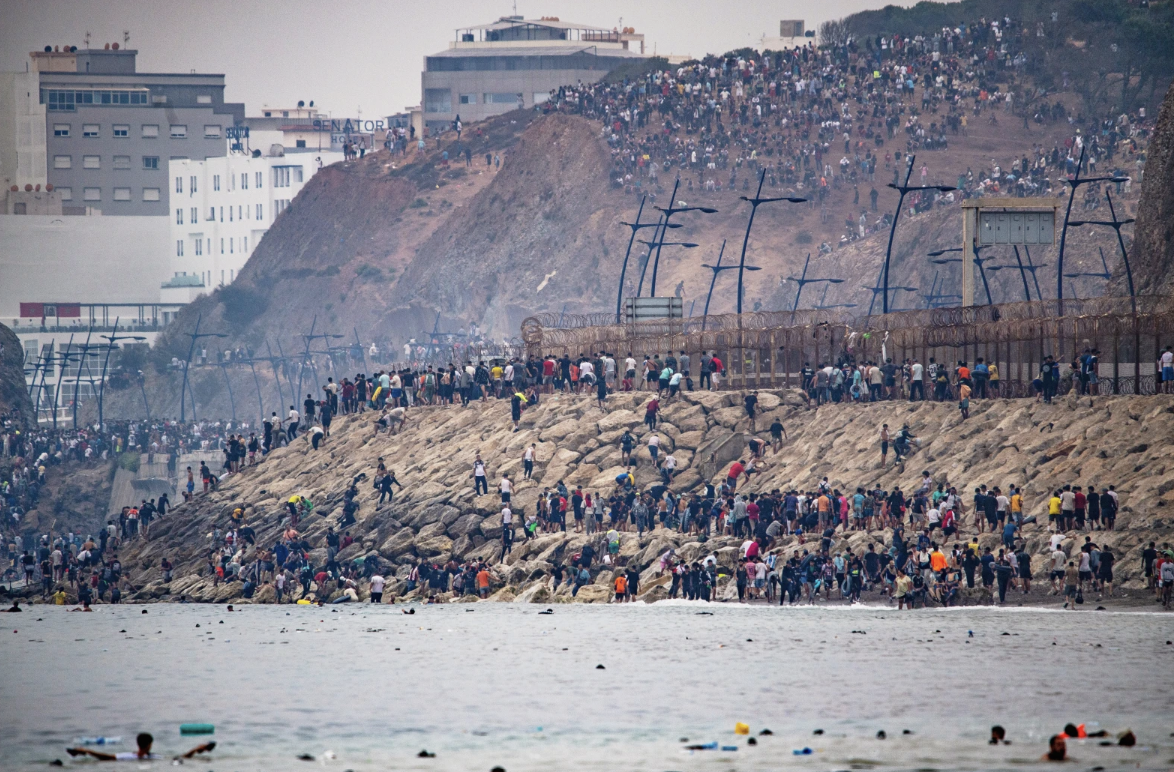
In recent years Spain has faced several border incidents from migrants originating in Morocco affecting the cities of Ceuta and Melilla. The most recent on 30-31st July 2026 involved an estimated 80,000 people crossing from Morocco into Ceuta and Melilla. This event’s importance is marked by Spain’s role as a major arrival point into Europe from Morocco and other parts of Africa, as people seek economic opportunities or escape violence and instability. Many people often try to swim from nearby Moroccan towns to reach Ceuta or climb over the border fence.
Initial response to the border incident
Following the initial crossings, the Spanish military and police supervised a mass movement of young men back to Morocco on Saturday 2 August, with 90% of the 60,000 Moroccans who arrived in the first 24 hours being returned by Saturday night. Spain applied for emergency financial aid from the EU on 24 August and later requested support from EU agencies including Frontex, which helps Schengen countries manage the EU’s external borders. The European Commission approved and granted 114.7 million euros to help Spain reinforce its border infrastructure and surveillance.
It is unlikely that the border incident would have caused major security problems for Spain or other EU member states, given the separation of Ceuta from mainland Spain by the Strait of Gibraltar and the carve-out of the city from the Schengen area meaning additional border checks are required.
Factors behind the border crossings
There has been a large amount of speculation regarding the cause and objectives behind the migrant crossing, with several scenarios and factors being articulated.
Given the lack of evidence, speculation that the mass border crossing involved the Israeli government is unlikely to be accurate. However, possible Israeli motivations to disrupt Spain could be linked to the country’s recent objections and measures against Israel linked to ongoing events in the Gaza Strip.
It cannot be ruled out that the Moroccan government allowed the incident to occur given previous border crossings being linked to international and regional disputes. For example, a mass border crossing in May 2021 occurred following looser border controls by Morocco during a diplomatic row with Spain after the government allowed the leader of the Western Sahara independence movement into the country to be treated for Covid-19. However, the row subsided in 2022 after Spain backed Morocco in the Western Sahara which in turn caused diplomatic tensions between Spain and Algeria.
The Moroccan government blamed the most recent border crossing on “criminal organisations”. While Spain initially stated Morocco officials attempted to stop the migrants, a police report on 2 September stated that Moroccan border forces showed “total permissiveness” during the incident. Reasons for potential Moroccan “permissiveness” around the recent 2026 crossing could be linked to the rivalry between Morocco and Algeria, and a recent trip by the Spanish prime minister, Pedro Sánchez, to Algiers. Sánchez visited Algiers on 20 July shortly before the mass crossing.
Social media is another probable factor in the high number of crossings as this may have helped encourage the Moroccan migrants by spreading the message that “Spain is Open.” Many social media posts were made in July encouraging people to make the crossing between Morocco and Ceuta following a ruling by Spain’s Supreme Court in June which stated that migrants arriving by the sea could not be formally deported.
Changes to Spanish immigration policy
Changes within Spain’s immigration system are likely to have changed the calculus for migrants attempting to cross the border and settle in the country. The Spanish government made changes to its immigration policy in January, which made it easier for undocumented migrants within the country to apply for work and residency permits. It is highly likely this policy was announced to increase the number of young people working in Spain as its population ages. Importantly the scheme only applied for people living in Spain prior to 1 January 2026 and had resided in Spain for at least five consecutive months. It is understood the majority of these applicants hail from Latin America and entered Spain legally but overstayed their visas. However, it is probable that some Moroccans were encouraged to attempt a border crossing to Ceuta due to a misinterpretation of these changes, believing that they could resettle in Spain more easily than before.
It is important to note that while Spain is a part of the Schengen area, Ceuta and Melilla both have special rules meaning additional checks are required for travellers moving by sea or air, including to the Spanish mainland. Therefore, any migrants who enter either city are almost certain to fail entry into separate nations within Schengen, significantly reducing the risk to those countries.
Reaction within Spain
There was a strong negative reaction to the border incident within Spain and locally in Ceuta. Initial local protests occurred on a daily basis calling for migrants to be sent back or dispersed across Spain. Public protests were conducted nationwide on 2 September in opposition to the government’s response and calling for the President to resign over the government’s response to the migrant crossing. It is likely that the government will attempt to appease protesters in the short term with changes to Spain’s immigration policy, especially given the closeness of the next election, occurring at the latest in August 2027. Additionally protests occurred in Ceuta on 20 September organised by the Provincial Federation of Neighbourhood Associations (FPAV) supporting the resignation of the national governments delegate to Ceuta, Miguel Ángel Pérez Triano, who later resigned on 28 September claiming a “constant campaign of harassment.” Further protests occurred in Madrid on 26 September with over 200 organisations supporting it. Protests demanded elections and the militarisation of the Ceuta border.
Reaction from other countries
The Italian government responded to the crisis by calling for Spain to be suspended from the Schengen agreement with Italy, restricting the free movement of people, citing a security threat and blamed the incident on the Spanish government’s recent migration policies. Over the following weeks, travellers from Spain to Italy faced random document checks by police. Italian government officials suspended passport-free Schengen travel arrangements with Spain for a month on 4 August and stated that Italy would demand EU-funded migrant processing centres and return hubs in third countries. Given the nature of the current Italian government, and its recent immigration policy changes, it is unsurprising that this reaction was negative, however the high level of the response and its harshness was unexpected and shows a more combative tone. One of possible reasons for this response is Giorgia Meloni’s fears about losing national elections in 2027, with her party, Fratelli d'Italia, losing ground to alternative parties on the left and right. This announcement was likely made to demonstrate a tougher position on immigration and win back support.
A joint letter was issued by 22 EU member states demanding external borders be strengthened and a coordinated response to the migrant crossings. States expressed concern over hybrid threats including social media being used to encourage illegal entry. The letter’s signatories said they were ready to reinforce or reintroduce “temporary internal border controls” in the bloc.
European Interior Ministers held emergency talks on 4 August to reduce tensions between member states over the incident. The Member States showed support for Spain’s response, advocated for action against smugglers and improving partnerships with third party countries. The Danish Prime Minister urged member states to consider all options including suspending cooperation within the Schengen area.
Will Spain be removed from the Schengen Agreement
Given the failure to stop large numbers of illegal migrants from entering Spanish territory in Ceuta it is almost certain that other EU nations will revise or consult on future immigration laws and agreements to ensure border security and sovereignty on immigration policy. While it is unlikely that Spain will be removed from Schengen, this incident is likely to increase tensions between Sanchez and other European leaders in the short term given the signed letter and accusations made immediately following the incident, this is especially true for Spain-Italy relations.
There is cause for concern, given the precedent on immigration incidents within this geographical area, that Spain was not better prepared for a similar incident to occur again. This raises questions regarding the country’s immigration policies and border forces and whether changes in funding or policy need to be made to ensure a secure border, particularly given the country’s current membership within Schengen.
Does the Spanish failure to control immigration mean the EU’s immigration policy is broken?
Despite the controversy surrounding the border incident it is unlikely that this event will cause any long-term harm to the EU’s broader immigration policy nor the Schengen area agreement. In fact, many interior ministers met with Spain on 4 August to endorse their support and work to improve the border and reduce the number of crossings.
Additionally, the border between Ceuta, Melilla and Spain has long been a problem regarding undocumented immigration and the Schengen area has long survived previous border incidents in the area. Therefore, while this latest problem was greater in scope it is unlikely that this will cause any longer term changes to EU immigration and border policies. However, it is probable that Spain will feel under pressure to change its immigration laws and regularisation schemes, given the correlation being made between these policies and the higher numbers of undocumented migrants.
Impact on the EU’s anti-immigration debate
While this border incident is currently back under control it is likely that governments and political parties with anti-immigration policies will use this event as an example of the apparent failures of the EU immigration system and demand additional restrictions be placed on those entering from third party countries.
There is a realistic possibility that political parties which support harsher immigration policies will see higher polling numbers in the following months, particularly in countries bordering non-EU countries.
It is unlikely, but cannot be ruled out, that this incident will cause future EU immigration policy to be made harsher due to re-evaluation. However, given the strength of the existing frameworks this is unlikely to happen.
Conclusion
This latest border incident highlights the increasing polarity and controversy that is possible when social media emphasises these events and the problem of simple messaging being spread creating increased discourse. It shows the dangers of misinformation and how these can spread quickly. The EU and its member states should take lessons from this incident and ensure their response involves concise and clear messaging to citizens and foreign governments.
Social media is increasingly likely to reinforce the long standing and growing reasons for immigrants seeking to come to the EU. At the same time, national politics within EU members means that immigration and large scale illegal border crossings carry a higher level of focus and reaction than previously. This will put short term pressure on agreements like Schengen but in all likelihood Schengen is unlikely to change in the medium term. What is more likely is that EU members will require stronger defences against border crossing and robust responses from member states.

Written by Thomas Acratopulo
Contributing political risk and intelligence analyst