A cross-regional research desk, it focuses on emerging national and international security threats, their geopolitical implications and potential disruptions to relevant stakeholders.
Intelligence Briefings

Security Risk Assessments of the UK
Executive Summary:
-
The UK continues to face security threats from a wide range of domestic actors, both novel and familiar.
-
Partly in response to these threats, the UK Government has implemented several restrictive and surveillance measures over the past five years.
-
Such measures have prompted criticism from international organisations and the Press, but no direct public outcry or resistance.
-
A lack of reactionary unrest may be down to a lack of understanding of the UK’s security apparatus among citizens, other more salient concerns, or a more apathetic political culture.

Disciplining Hate: The Rusich Group, and Neo-Nazi Paramilitarism in Russian Hybrid Warfare
Executive Summary:
-
Since 2009, The Rusich Group has continued to support Russia’s geopolitical objectives. The paramilitary formation operates in a legal and conceptual grey zone, benefiting from the Kremlin’s broader hybrid warfare model that indirectly tolerates and, in some cases, tacitly co-opts extremist actors when it is strategically beneficial. This ambiguity allows networks like the Rusich to carry out extremist violence while mitigating state accountability under the façade of plausible deniability.
-
Alexey Milchakov’s trajectory from a subcultural actor to a paramilitary commander illuminates how neo-Nazi subcultures rooted in hooliganism, hyper-masculinity, and ritualised violence, serve as informal recruitment pathways into Russia’s paramilitary ecosystem.
-
The group’s involvement in the Donbas region in Ukraine and the oil-rich Homs Province in Syria, and the Sahel, has included conventional and unconventional warfare, and symbolic violence, furthering Russia’s geopolitical influence.
-
Rusich continues to receive indirect support through informal logistics, personnel movement, and digital fundraising, particularly via Telegram and associated networks. These shadow networks bolster the resilience of many of Russia’s extremist proxies.

The Kashmir Crisis and Security Fragmentation in Western Pakistan: IS-KP, TTP and Baloch Separatism
Executive Summary
-
Escalating conflict with India in Kashmir has redirected critical military and intelligence resources from Pakistan’s western periphery, weakening counterinsurgency efforts. This security vacuum has created an opening for jihadist networks and ethno-nationalist insurgents operating along the Durand Line and in Balochistan to exploit the growing internal instability.
-
The Islamic State-Khorasan Province has displayed advanced operational adaptability in retaining its ideological relevance and funding. Its use of cyber-financing and multi-lingual propaganda has allowed the network to slowly build its operational capabilities.
-
Tehrik-e-Taliban Pakistan remains one of the world’s deadliest insurgent networks, while the Balochistan Liberation Army has intensified its activities. In recent years, Pakistan’s security services have warned of increasing strategic convergences between the two factions; however, an outright alliance remains improbable.
-
Pakistan’s increasingly fragmented security apparatus risks ungoverned spaces being exploited by militant actors. While collaboration between these factions is unlikely, unilateral strikes with little formal coordination may prove to.

Beneath the Black flag: The Islamic State’s Resurgence in Syria
Executive Summary
-
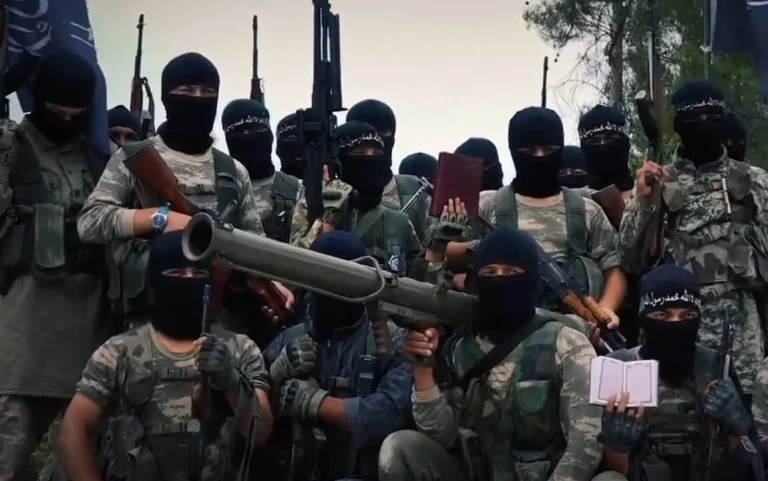
Conditions that once enabled the Islamic State to establish a territorial caliphate over the summer of 2014—including fragmented state control and security vacuums—have partially re-emerged in pockets of Syria following the overthrow of the Assad regime in late 2024, creating fertile conditions for a renewed insurgency.
-
While significantly weaker than during its peak, and operating through a more covert decentralised modus operandi, IS has diversified its economic portfolio, demonstrating operational and ideological resilience since the total collapse of its former proto-state in 2019.
-
A fractured environment, poor operational structures, and lingering extremist sentiment in post-Assad Syria can easily facilitate the expansion of IS’ operational capacity.
-
The United States’ isolationism under President Trump could serve to embolden IS, as Syrian forces struggle to quell the group as an American withdrawal is underway, leaving a power vacuum in its wake.
-
Tensions between Turkish-backed forces and Kurdish-led Syrian Democratic Forces (SDF) have diverted attention from counter-IS initiatives while placing immense strains on the SDF managing IS detention centres.
-
The potential knock-on effect of an IS resurgence at a domestic level entails a great risk of a resurgence and reinstatement of IS at a global level, potentially catalysed by the lack of foresight of foreign powers.
-
Regional opportunities for stability are presented through Kurdish-led forces, with the integration into a broader Syrian centralised armed force, fortifying efforts to combat IS whilst potentially providing a common objective that could stabilise the state.